
The Scaling Playbook
Persona-Based Marketing
This past month, I did a deep dive on the marketing that resulted in Gruns’ $1.2 billion exit in under three years. One of the biggest takeaways for me was their persona-based marketing. The more I dug into that approach, the more I realized that many of the top direct-to-consumer (DTC) brands—and even non-ecommerce brands—use this same approach.
Rather than just creating ads you think might convert or just copying ads that have worked for other successful brands and trying to apply them to yours, you start with who is buying. What are the general demographics and psychographics of the primary buyers for your product? Then, once you have an idea of the top 3-5 current (or potential) personas, you dig into what they care about (those become your angles to speak to those customers). The combination of persona + angle equals your ad messages.
The value of using persona-based marketing is that you are able to speak specifically to individual buyer types and create messages that make them pay attention and, ultimately, buy. Now with Meta advertising, you create hyperspecific messages that reach the exact right people at scale, which is a HUGE opportunity for brands.
How to implement persona-based marketing today:
- Download/export as many reviews as possible from your product (via Shopify, Amazon, and anywhere else) and/or your top competitors’ products. (Tip for exporting Amazon reviews: The ability to export reviews is always changing, so, worst case, you can always use a full page screenshot Chrome extension like this one to screenshot your top 100 reviews and top 100 most recent reviews.)
- Use the “Buyer Personas Prompt” below in your favorite AI chat tool (I prefer Claude) to get an ordered list of the top persona categories of people buying your product along with what they care about and specific review quotes.
- For your next ads, create them by thinking of 1) who is buying (persona) and 2) what they care about (angle). Nail down the message before deciding on the format (image, video, UGC, etc.).
- (Advanced) Once you figure out a persona and angle that’s working well, create a modified version of your landing page, product page, or sales page, tailored specifically to that proven persona for an even greater lift in performance.
I’m going to paste a list of Amazon reviews for [YOUR PRODUCT NAME]: [YOUR AMAZON OR SHOPIFY PRODUCT URL]
Analyze the reviews I provide and give me:
1. Top 3–5 Buyer Personas, ranked by how commonly they appear in the reviews. Each persona should describe a type of person — not a benefit category. Think: life stage, daily routine, identity, or role (e.g., “retired woman in her 60s–70s,” “busy mom adding it to her morning coffee routine,” “middle-aged man who works out regularly”). Clues to look for in reviews: age mentioned, gender, life circumstances, daily habits, how they found the product, what else they take alongside it.
For each persona:
- — A short label that describes who they are as a person (not what they want from the product)
- — Who they are in 1–2 sentences — only using details explicitly stated in the reviews. No invented details.
- — 5–7 reasons WHY this type of person is buying the product, in their own language
2. 10 Standout Customer Quotes verbatim from the reviews that reveal motivation, a specific benefit felt, or an objection overcome.
Ground rules:
- — Personas must describe people, not benefits.
- — Everything must come directly from the reviews. If it’s not stated, don’t say it.
- — Rank by frequency — most common persona type first.
The reviews are in the attached uploaded files.
The Ad
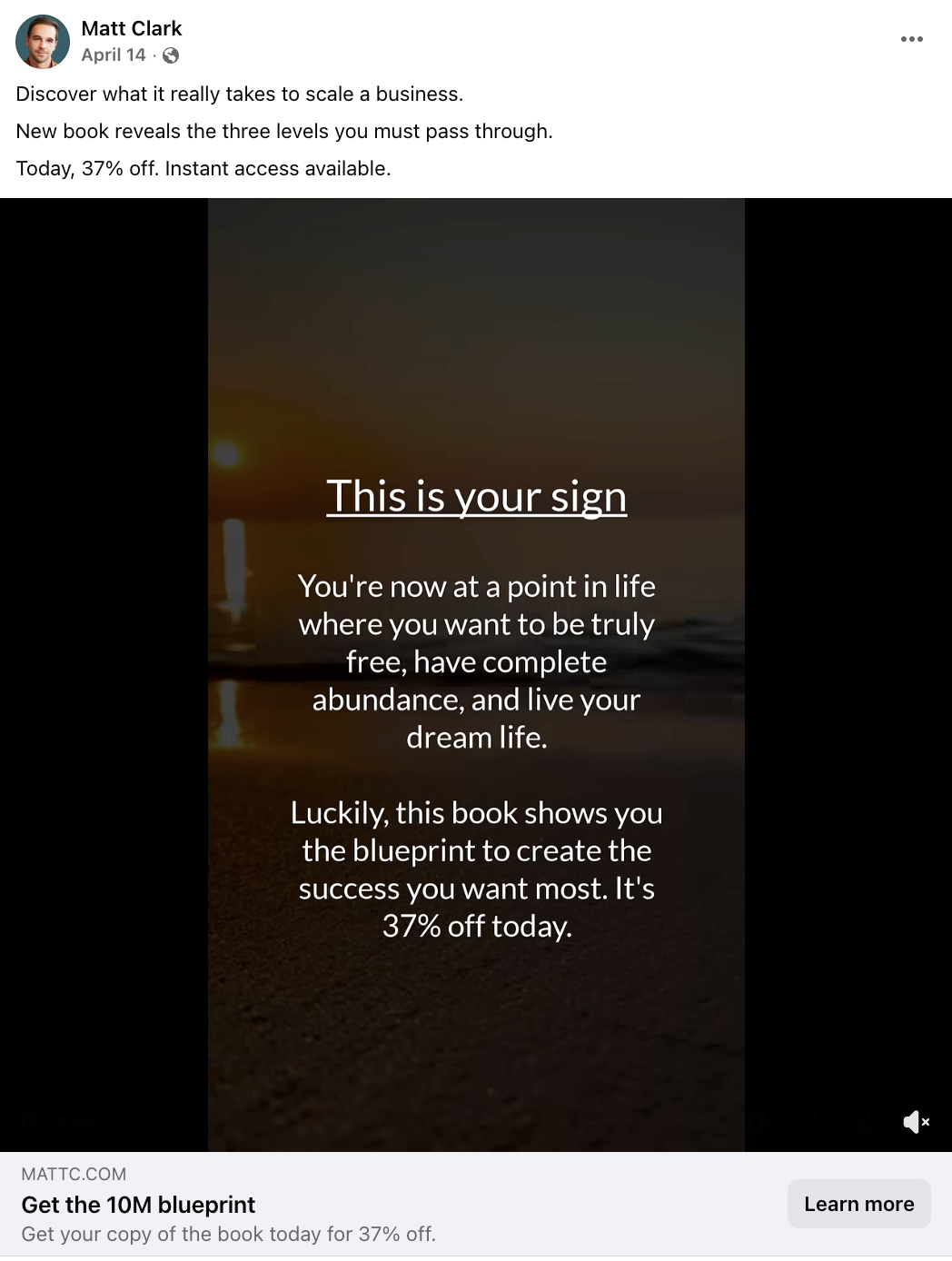
This simple ad is currently producing a cost per purchase for my 10 MILLION book funnel of $42.13 on a target cost per result of $55.
Over the last 7 days, it’s produced the second highest number of sales for this offer at the lowest cost per purchase.
This ad took all of 10 minutes to create. That’s why it’s such a powerful lesson in creative.
The video: A simple 12-second video with white text overlaid on a background of an AI-generated ocean at sunset clip with moody background music. I modeled the text overlay copy after a newsletter ad I found (I believe for Mark Manson or Sahil Bloom).
The headline—”Get the 10M blueprint”: I prefer shorter, punchier ad headlines so they don’t get cut off (happens after just 27 characters). To maximize Meta ads approval and compliance issues avoidance, I deliberately avoided using a dollar sign before “10M”.
The post text copy—”Discover what it really takes…”: I lead with what I think matters most to a potential buyer (scaling a business). I then added curiosity (“New book reveals…”). I end with a simple discount-focused CTA since this is a lower-priced product.
Video
- Text overlay
- — “This is your sign” (can work for almost any product or business)
- — “You’re now at a point in your life where [insert specific audience/persona desire].”
- — “Luckily, this [product] shows you [solution that addresses desire]. it’s [discount info].”
- Background generation
- — Ask an AI chat tool (I like Claude) to produce a prompt for your background video clip. Use this prompt + paste in your text overlay copy above: “I want to produce a simple, cinematic, moody background clip of an environment that’s natural to this ad content below. Give me a prompt I can use in a separate AI video generation tool to generate this background clip.”
- — Use any AI tool such as Veo by Google, Higgsfield.ai, or Kreator.ai (I’m a co-founder) to generate the clip.
- Music generation
- — Ask your AI chat tool to produce a prompt for your background music as well. Sample prompt: “I want to generate background music for my video. I want it to feel moody and dramatic. Give me a prompt I can use in an AI music generator that I can just copy and paste to generate this background music clip.”
- — Use an AI music tool such as ElevenLabs, Higgsfield.ai, or Kreator.ai to produce background music for the video.
- Combine the above elements into a 10-15 second video using any editor such as CapCut or Camtasia
- Make sure your overlay text falls within the Meta safe zone so your text doesn’t get cut off or hidden. Check with a tool such as this: https://adkit.so/tools/safe-zones
Ad Copy
- Headline: “Get the [product benefit]”
- Post text:
- — “Discover what it really takes to [main benefit].”
- — “New [product] reveals [curiosity-driven process or feature].”
- — “Today, [discount]. Ships immediately.”
- Link description (generally not as important): “Get your [product] at [discount] today.”
The Funnel
We’ve been testing this funnel for a month or so now. It’s not working.
The cost per purchase is too high on cold traffic.
I think it’s not working because there’s no lead-in copy. We go straight for the “kill”, including the offer section at the top.
This funnel was created by an outside agency with a lot of ad experience (but maybe not as much funnel experience). I assumed that it would work because they work with a lot of top DTC brands.
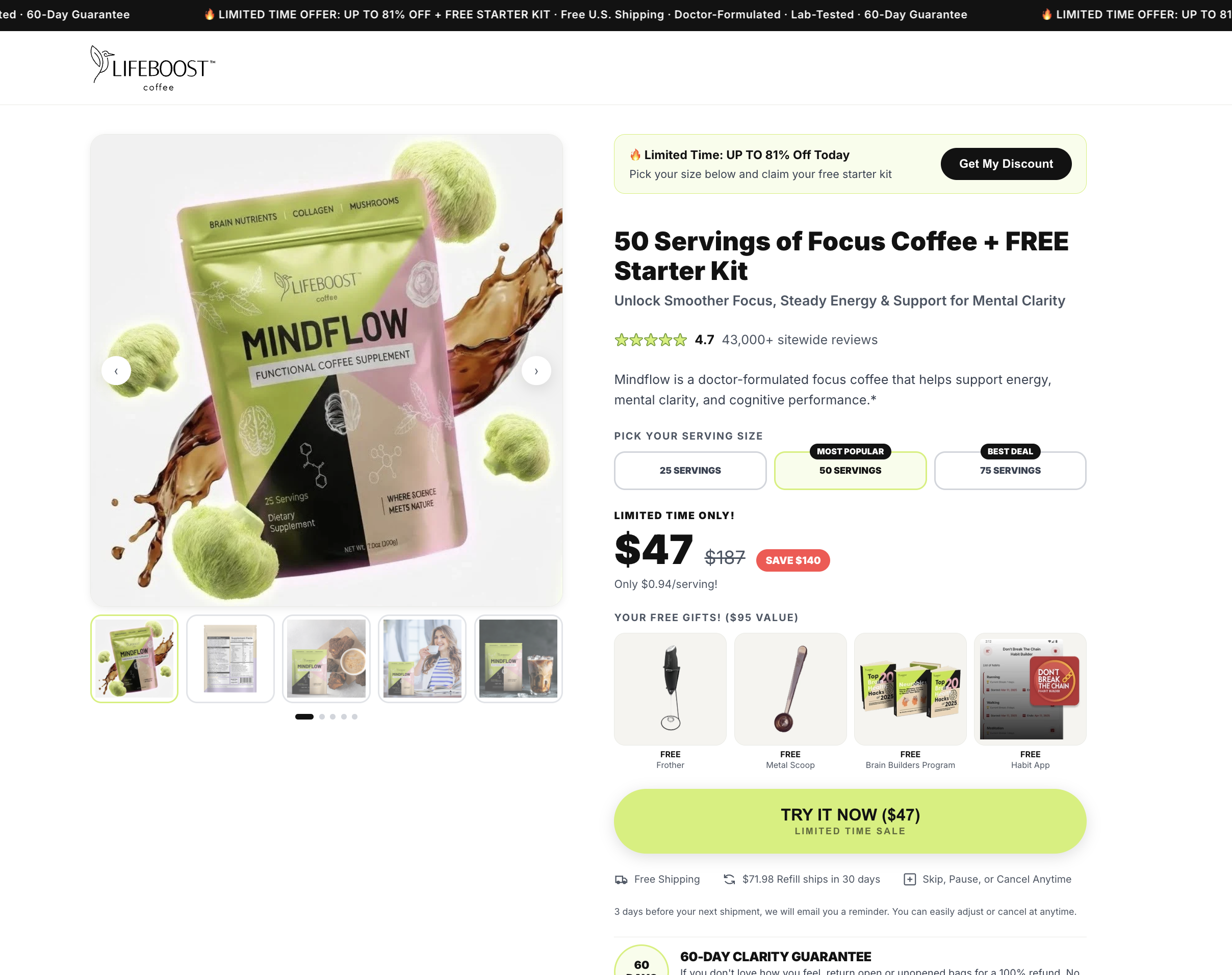
Back to the basics. Convince people of WHY they should buy your product before trying to sell it to them (something I’ve preached for 15+ years now).
We’re working on a listicle-style lead-in section for this same exact page. I just got it yesterday, and it looks awesome:
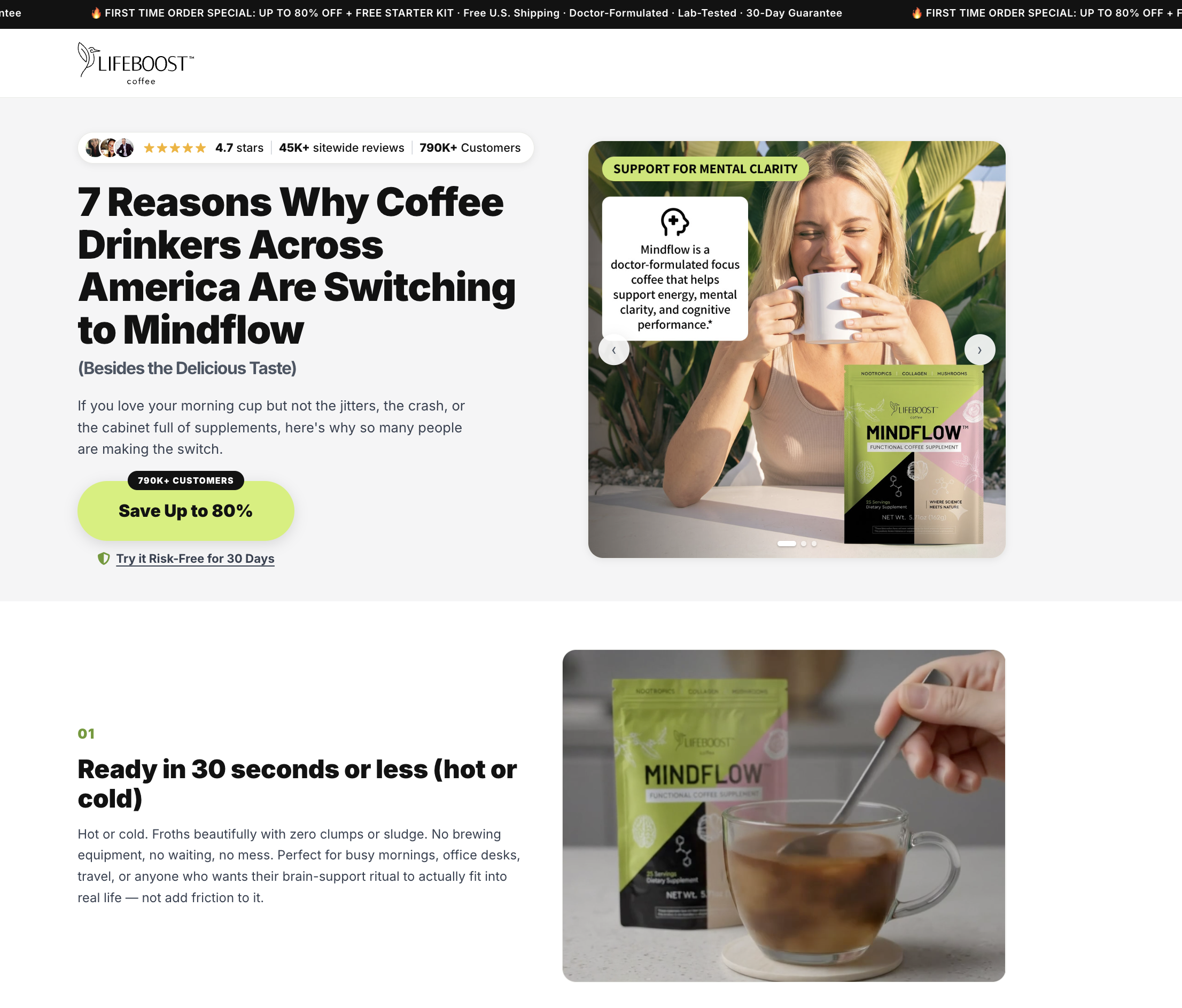
In next month’s Playbook (August 2026), I’ll share updated results of this new funnel test.
Amazon Prime Day 2026
We just had our best Amazon Prime Day yet in terms of revenue and profit. Here were the results:
We produced 97% more revenue and 200% more profit.
Last year (2025), we ran no “deals”. We just kept our Subscribe & Save coupons on and let ads increase with the extra traffic around the event.
This year (2026), we killed the Subscribe & Save coupons so they wouldn’t stack, ran Prime Day deals, and capped our ads at about half of a normal day of spend.
The deal momentum played well with the reduced ad spend resulting in much better efficiency and more profit.
Even though big events like Prime Day, Black Friday, Christmas, and other major holidays, you can still test new hypotheses and strategies each year.
You’re going to likely be in business for many years and the cumulative effect of these learnings compounds over time to produce a much bigger, healthier, more profitable business.
CPMr
CPMr = Cost per 1,000 unique people reached = CPM x frequency (or total spend / unique reach x 1,000)
Lifeboost’s CPMr:
This is a new metric for me. From what I know about it, these numbers are EXTREMELY HIGH.
Our CPM (cost per 1,000 impressions), is more around $30. When cost per 1,000 unique people reached (CPMr) starts getting too high, that means Meta is serving ads to the same people again and again and again…
That’s why some of our campaigns have a frequency of 12+. Not good.
I just messaged our media buyer.
Time to dig in.
Will report next month.
Look in your Meta ads reporting and pull your CPM and frequency. Multiply the two to get your CPMr. Compare performance year-over-year (same YTD period or same last 7-day period).
If you’re paying to show ads to the same people, versus getting new people, you either need to 1) get new creatives that target different personas with different angles OR 2) add more audience exclusions.
The Resource
I started using https://www.trendtrack.io/ in place of logging into Facebook Ad Library and clicking on dozens of ads to find their landing pages.
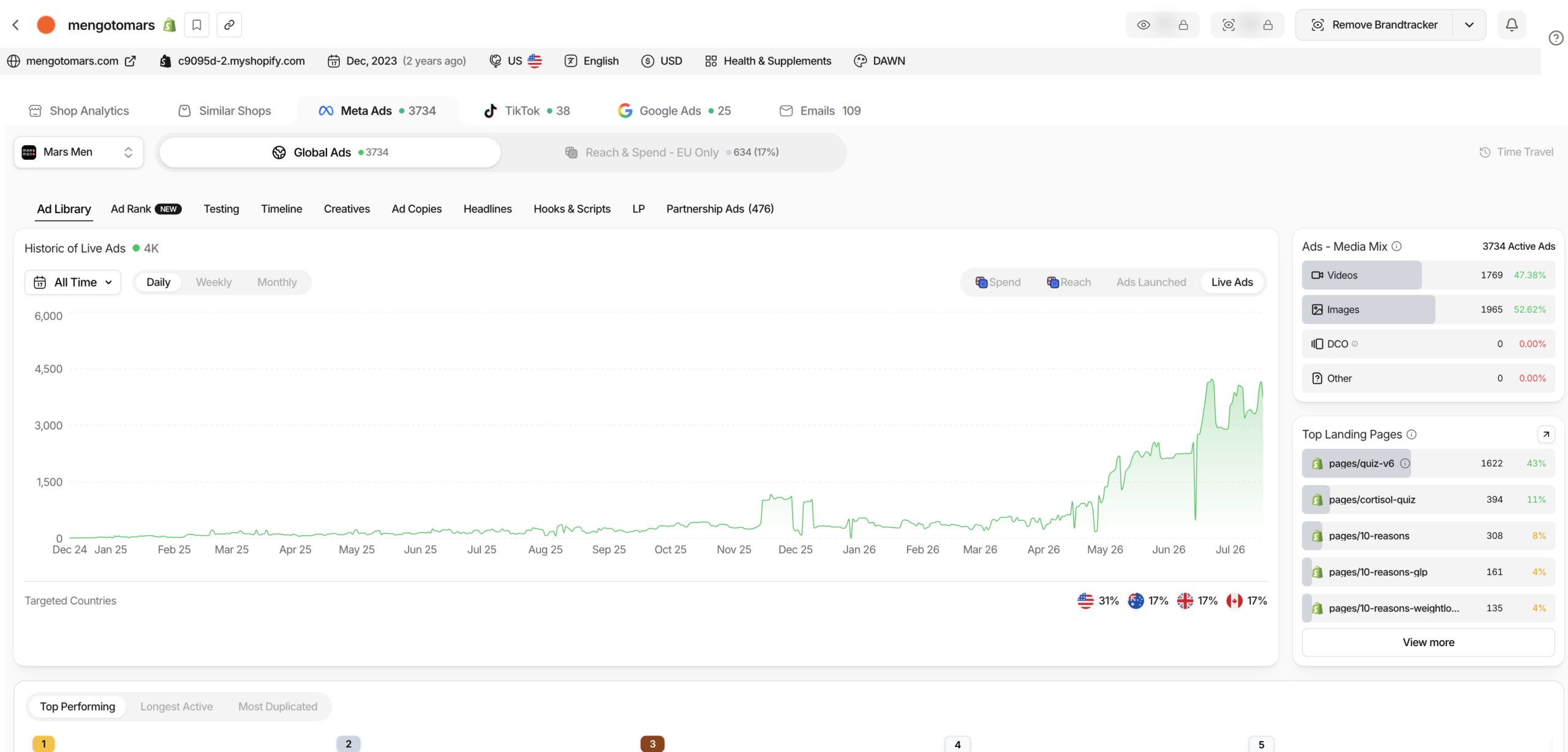
This tool lets you track brands, quickly see their best-performing ads, filter ads by type, and easily see their top-performing landing pages.
Big fan right now.
To scaling big,