

The purpose of starting a business is NOT to be the CEO.
The purpose of starting a business is to do what lights you up while making a lot of money.
But what happens to most business owners?
They become overworked, underpaid, stressed-out CEOs doing work they don’t enjoy while dragging their businesses through each month, only to repeat the same thing all over again the next month.
Fortunately, there’s a way out.
I’ve done it 3 times.
I’ve been building businesses for 17 years. My companies have sold over $460M so far. I am currently one of the largest owners of 3 businesses with combined sales of around $100M per year.
And I’m not the CEO or responsible for the day-to-day operations of ANY of my companies.
Here’s how.
The Replacement Protocol
There are 5 steps to get out of running a business forever. I call them the 5 R’s:
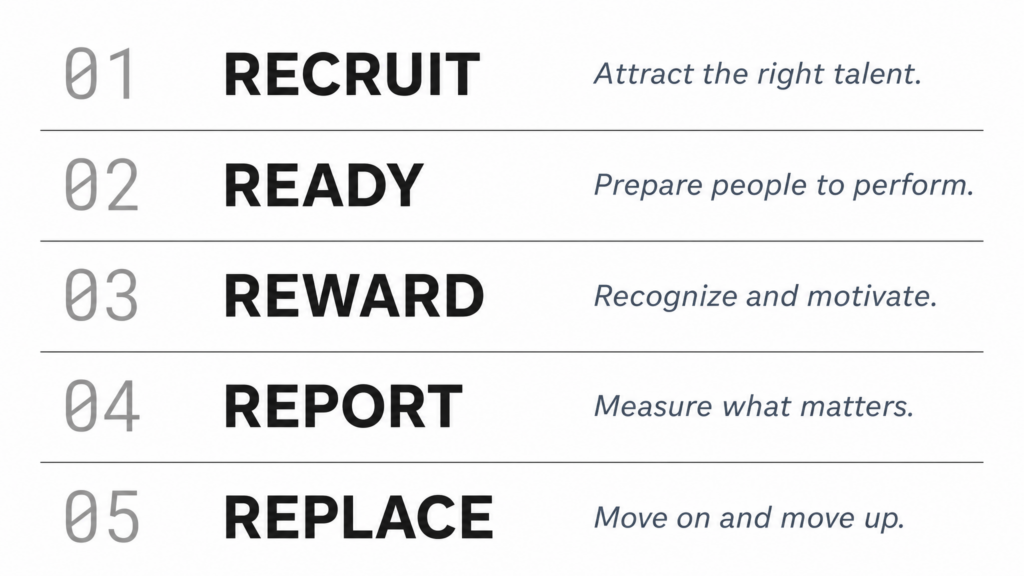
1 – Recruit
The first step is to recruit someone who can take on much greater responsibility, including eventually running your entire business for you. This person might already be on your team.
There are two good paths to recruit this type of person in my experience.
Contractor-to-CEO
Mike McClary, CEO of my company Amazing.com, started as a student of our Amazing Selling Machine (ASM) program. He started sharing advanced Amazon strategies with our students, and we brought him on as a contract co-instructor of ASM.
He later became a full-time W2 employee and eventually the CEO of the business.
We got to test out working together for many years before he became CEO.
Entree level employee to CEO
Our two highest-level employees at Lifeboost Coffee, one who runs operations, the other who runs marketing, started as lower-level employees with Charles many years ago.
Now they run 90%+ of Lifeboost.
Do this
- Make a list of all your current contractors and full-time employees
- Note who you think has the right values, mindset, and potential to do much more
- Start giving him or her greater and greater responsibility
Quick note (get the full video breakdown for free)
Yesterday, I just recorded a 45-minute video on this protocol. In the next couple of weeks, I’ll post it to my YouTube channel. Subscribe here so you get it when it’s available.
2 – Ready
Once you have one or more people who could end up running your company for you, it’s time to start developing them, much like surgeons are trained.
Imagine you own a large, successful hospital and you need to hire another surgeon. What do you not do? You don’t hire a brand-new surgeon out of college and let them start chopping into your patients.
Surgeons are first trained in books in school. Then they work on cadavers and medical dolls. Then they get to observe surgeries performed by experienced surgeons. Then they get to participate in small parts in live surgeries. Only then, and still under close supervision, are they allowed to perform live surgeries on their own.
With any employee, especially someone that you’re entrusting to run your entire business or a large part of it, follow the surgeon model. Give them a small amount of responsibility at first and watch them closely. Slowly increase how much responsibility you give them, always with close oversight, until you fully trust they can produce the results you need in your business.
Do this
- Start giving the person(s) you want to develop more responsibility, slowly
- Observe their work and results, and give them feedback regularly so they can improve
- Let them make mistakes (with guardrails) so they get better and better
3 – Reward
There are three components to a high-level manager’s compensation:
- Salary
- Bonus
- Equity or profit share
The goal of compensation is to align the manager’s incentives with your own.
Start by paying a market-based salary so that the manager isn’t worrying about paying her bills and isn’t constantly looking for another job.
Create a bonus structure tied to performance within her areas of responsibility. This bonus can be 20-100%+ of her salary, depending on performance.
As she takes on more of the business, align her performance with yours by offering an equity-like compensation component. This could be actual equity, though that is the most complicated and problematic, and is not recommended in most cases. This could also be a simple profit-sharing plan. The goal is to enable her to contribute to the company’s overall performance.
4 – Report
As you move from operator to owner, you need a reporting system to track how the business is performing without being neck-deep in day-to-day operations.
The Daily Pulse Report
Every day, I receive an email from an employee overseas with a few key metrics for the prior day, including sales and subscription counts for Lifeboost.
I recommend you set up a similar daily report that someone sends you in the body of an email. Include no more than 5 key metrics, so you stay focused on what matters most.
Monthly Financial Package
Have your bookkeeper or CFO prepare standard financial reports, including profit and loss, balance sheet, and cash flow, ideally by the 15th of every month.
Review those reports in detail with your bookkeeper or CFO. If you don’t understand something, ask questions until you do. Your investment in understanding financial reports will pay off for the rest of your business life.
5 – Replace
Not every hire, including every high-level manager you develop, will work out long-term.
That’s OK. Try again.
I once heard the process of going through multiple CEO hires called “building scar tissue”. You learn each time how to better hire, develop, and monitor high-level managers each time.
If the person you want to run your business doesn’t work out, replace them. Eventually, you’ll find someone who can run your business as well as (if not better than) you.
Do the work you love to do
The goal of The Replacement Protocol is for you to do the work that lights you up.
The goal is not to do nothing. Extreme freedom makes us miserable (that’s the subject of this Friday’s newsletter).
What we all crave is purpose.
Get someone to run most of your business so you can do the work you enjoy most and find the most meaningful.
The world needs more entrepreneurs on fire.
—Matt
P.S. In the next couple of weeks, I’m releasing a much more detailed breakdown of these 5 steps in a new video on my YouTube channel. Subscribe here to get the video as soon as it’s available.