

In the 1920s, William Barnard’s family member used natural remedies to heal a chronic illness. Barnard became a believer in the power of whole foods. He started selling 25-cent can openers through live demonstrations to give people access to whole foods year-round.
In 1937, Barnard released his own stainless steel “health machine,” The Vita-Mix.
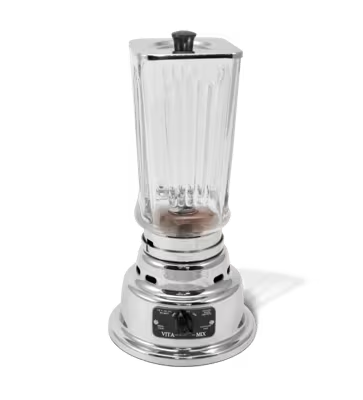
Today, Vitamix sells hundreds of millions of dollars of blenders annually. I own two Vitamix blenders, one of which I’ve had for almost 10 years. They’re not cheap (mine cost around $500), but I would never buy another blender.
John Sylvan introduced the first Keurig coffee maker in 1998, 61 years after Barnard introduced the Vita-Mix.
Today, Keurig produces around as much revenue from its devices as Vitamix, yet it generates six to ten times as much total revenue. How?
The pods.
Keurig sells $3.6 billion in high-margin, lightweight, consumable coffee pods annually.
Keurig became a much bigger business because it makes more per customer. While Vitamix blenders often cost more than Keurig machines, Keurig users spend up to $900 per year on pods. That’s like buying two $450 blenders every year for the rest of your life — not going to happen when Vitamix blenders last forever.
Most people think scaling a business is hard. It’s easy when you know the nine words I’m about to share with you — and you don’t ask ChatGPT how to scale a company.
ChatGPT is a Terrible Chief Marketing Officer
I asked ChatGPT a few days ago how it would scale a fictional e-commerce company selling nutritional supplements from $1 million to $10 million in annual revenue. I told it the brand has four products, each selling around $250,000 per year, the company has five employees, it sells 60% on Amazon and 40% on Shopify, and the current net profit margin is 10% (after paying myself, the owner, a salary of $50,000 per year).
Here were ChatGPT’s suggestions about how to scale this business:
- Expand the product line
- Ramp up Meta, TikTok, and YouTube ads
- Also, use influencers and UGC
- Hire a growth lead or agency
- Hire an operations manager/SKU development lead
“ How to scale the business the fastest?” I asked. “Explode SKU count.”
All wrong.
If you do any of those at the wrong time, much less all simultaneously, you are guaranteed to burn all your cash and watch all your profits evaporate.
ChatGPT, it seems, doesn’t know the nine-word secret to scaling.
The 9-Word Secret to Scaling
In 2012, we launched the first Amazing Selling Machine (ASM), our online training program that taught people how to build businesses with Amazon. In one week, we sold $1 million worth of memberships. The first launch of the following year, we sold $6 million. Then, $7.5 million. Then $15 million. Our biggest launch, in 2015, was over $20 million in two weeks.
How did we sell so much? We made influential people with email lists more money than they could make from promoting anything else.
That gives us the secret to scaling any business. Scaling is easy when you…
Make more money per visitor than ALL your competitors.
Those nine words cover everything you need to know about scaling. It doesn’t matter if it’s 1937 and you’re selling blenders, 1998 and you’re selling coffee makers, 2008 and you’re running Google display ads, or 2025 and you’re running TikTok ads.
If you make more money per visitor than all your competitors, you win.
This is true because there’s an unstoppable, unwritten rule that governs the business world.
Traffic Flows to Wherever It’s Most Valued
Business owners often say they “need more traffic”.
Traffic is never the problem.
The problem is always that you can’t afford the traffic. You don’t make enough money per visitor.
With a few clicks, you can reach over one billion people on any of the following platforms: Facebook, YouTube, Instagram, and TikTok.
Believe me, the owners of those platforms will gladly take your money.
The brick-and-mortar retail world operates the same way.
Right now, we’re in talks with a large U.S.-based natural foods retailer to carry our coffee brand on its shelves. Indeed, they care about the quality of our product. But what do they really care about, though? They care whether putting our products on their limited shelf space will generate more revenue than the products they have to remove to make room for ours.
Affiliates, influencers, and celebrities also operate by this rule. LeBron James promotes Nike products because Nike signed a deal with him valued at an estimated $1 billion. Tom Brady promoted the scam crypto company FTX because it reportedly paid him $55 million. Influencers and affiliates will promote your product — any product — if it makes them the most money (and, ideally, gives them some assurance that it’s not a total scam).
Traffic flows to wherever it’s most valued.
If Walmart puts the most profitable products on its shelves, while Target doesn’t, Walmart makes more money. The more money Walmart makes, the more it can spend on advertising and lower prices. Soon, Target will be out of business. Traffic flows to wherever it’s most valued because it’s the nature of capitalism itself.
If you make more money per visitor than all your competitors, you command all the traffic, all the customers, all the revenue you could ever want.
Conclusion
If your business is stuck or not as big as you’d like, it’s because you’re not making enough profit per visitor.
To increase profit per visitor, you need to get customers to spend more or convert more visitors into buyers.
If you increase the conversion rate from visitors to shoppers, get customers to pay more upfront, or improve how much customers re-buy from you, your company will scale. Do all three, and you’ll see significant sales growth because traffic will flow to you automatically. It must.
All the world’s largest retailers carry Keurig because it generates more revenue than standard coffee pots.
In 2018, Keurig merged with Dr. Pepper to become the $39 billion beverage giant it is today.
Unfortunately, Keurig’s inventor, John Sylvan, didn’t see the full potential of his invention.
Only a year after Keurig’s market launch, John Sylvan was forced out of the company over a disagreement with its venture capital investors. Sylvan required them to buy him out for $50,000.
Do This Now
If you’re not yet subscribed, join 80,000+ people who receive ideas and strategies to scale businesses like this in my 100% free bi-weekly newsletter, the Scaling Journal. Sign up below.
If you are subscribed, share this newsletter article with someone you think might get value from it.
Thanks for reading,
Matt Clark