

Common marketing advice is always to charge more. Raise your prices, they say, and profits flow like water released from a dam.
Wrong.
Sometimes, raising prices reduces profits.
It’s simple to see why once you understand Visitor Value.
From $17,000 to $600,000 Per Month in 12 Months
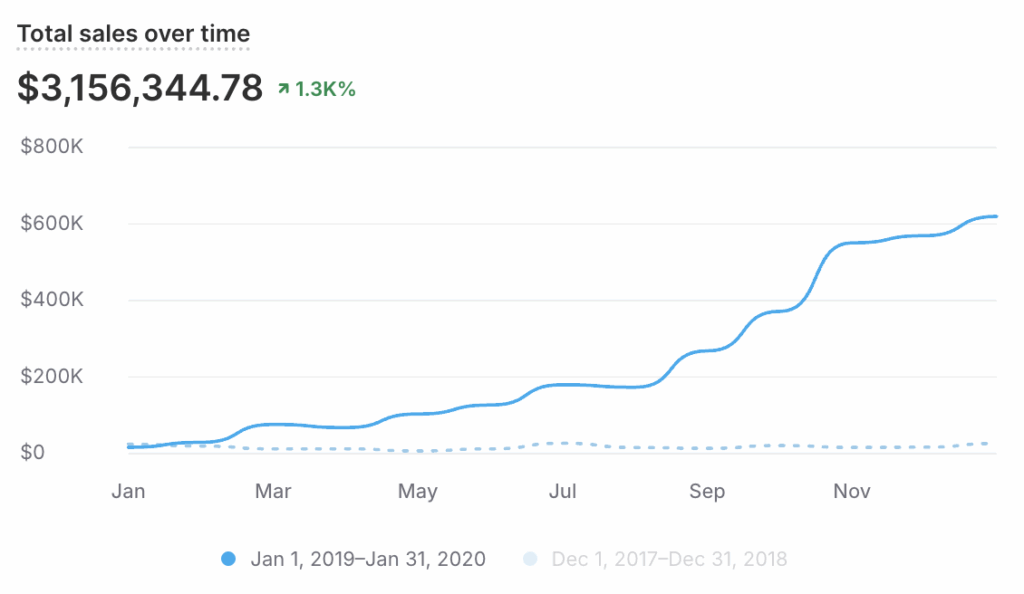
In January 2019, I began working to scale Lifeboost Coffee’s sales. Sales that first month were $16,738.04.
The first task was to get customers buying something, anything. Then we could optimize to increase profit.
I upgraded the sales copy of one of the landing pages. Then, we tested the overall hook or angle of the page, focusing primarily on the top 10% of the copy. We tested the headline and introductory paragraph, ensuring the ads we sent to each page version matched the test (ad one matched hook one, ad two matched hook two, and so forth).
We tripled the page’s conversion rate, increasing it from 2% to 6%.
Then, with the most effective hook confirmed, we tested the offer. We ran dozens of offer tests, including varying prices, multi-unit packs, and product bundles.
Offer testing increased our average order value (the total amount customers spent per order) from $40 to over $70.
Lastly, we improved how we got customers to buy from us again and again, especially by signing up for our automatic coffee subscription program.
One year later, our sales had increased 36X to $620,091.34 per month.
The Visitor Value Engine
In the previous newsletter issue, I said the nine-word secret to scaling a business is to “make more money per visitor than all your competitors.”
That’s the “what”; now, here’s the “how”. I call this concept, and its accompanying formula, the Visitor Value Engine.
Visitor Value = Conversion Rate x Profit Lifetime Value
Conversion Rate (CVR) is the total number of orders divided by the total number of visitors.
Profit Lifetime Value (PLTV) is the total amount of money customers give you over their lifetime as customers, divided by the total number of customers.
Here’s a simple example:
- 1,000 visitors
- 100 buy (10% conversion rate)
- Revenue: Those 100 customers spend a total of $12,000 over the first year ($120 per customer).
- Gross margin profit percentage (how much you make in profit on typical orders after excluding product costs, shipping, and payment processing) = 50%
- Profit Lifetime Value (PLTV) = 50% (Gross Profit Margin) x $120 (Lifetime Value) = $60
- Visitor Value = 10% (Conversion Rate) x $60 (Profit Lifetime Value) = $6
What does this formula tell us? Well, if you can get typical potential buyers to that page for under $6 (the Visitor Value), you make money. If it costs more than $6, you lose money.
What’s even more important is that you know precisely what to do in four scenarios.
The Four Stages of Effortless Scale
Scaling a business is like getting a plane off the ground. Most founders try to scale by bolting more weight onto the aircraft — more products, more channels, more agencies, more systems. That’s why they never get airborne. A plane takes off only when lift exceeds drag. In your business, lift is Visitor Value — raise that, and the business rises almost automatically.
Here are the four stages you must go through to make scaling your business effortless.
Stage 1: TRIM
- Results: low conversion rate (CVR), low profit lifetime value (PLTV)
- Goal: Increase conversion rate (get sales flowing)
- Action: Tweak the messaging and copy (if absolutely necessary, replace or fix the product)
When a plane needs lift, the pilot adjusts the trim to change the pitch with minimal effort. Same idea here: you tweak your hook, your angle, your pitch — conversion jumps, and suddenly your business has real lift under the wings. Your first goal is to get customers buying. Don’t worry about profitability yet. Focus just on getting customers to buy.
Stage 2: THRUST
- Results: high CVR, low PLTV
- Goal: Increase average order value (get customers to buy more upfront)
- Action: Add upsells, order bumps, and bundles. Test increasing prices to see if you can make more money per unit sold without hurting conversion rate too much.
Next, increase thrust by increasing what each customer pays on day one — pricing, bundling, upsells. This is where you get the force you need to break gravity. More upfront order value = more thrust = faster acceleration. At this point, you’re seeing sales and becoming more profitable up front. You’re getting ready to accelerate.
Stage 3: TANK
- Results: high CVR, medium PLTV
- Goal: Increase lifetime value (get customers to buy more after their first purchase)
- Action: Follow up with customers after their first order to encourage repeat purchases of the same product or complementary items, ideally, premium products.
Even with lift and thrust, you don’t get far without fuel. In your business, fuel is repeat purchases and lifetime value. When customers keep buying, your range increases and the flight becomes smoother and more predictable. Now that customers are spending more upfront, focus on getting them to spend more after their first purchase. That’s how you win in any market because customers are more valuable to you than all your competitors.
Stage 4: THROTTLE
- Results: high CVR, high PLTV
- Goal: Scale traffic
- Action: Increase traffic to scale your well-performing funnel.
Once you have lift, thrust, and fuel, you hit full throttle. This is when ads, traffic, and reach scale effortlessly. You aren’t dragging dead weight anymore — the plan wants to rise.
Summary
Once you get to Stage 4, your Visitor Value will be high, and you’ll be making more money per visitor than all your competitors. It’s at that point that you go full throttle and accelerate sales with more traffic.
As you can see, the solution to every business problem isn’t to raise prices. At some point, raising prices hurts conversion rate so much that you make less per visitor (lower Visitor Value).
We could charge $1,000 for every bag of coffee we sell. Somebody will buy it. But that could only be one out of a thousand. By raising prices, we damage our sales, profits, customer base, and company value.
Instead, work sequentially through the four stages and watch your business take off.
Get the Exact Steps to Increase Conversion Rate and Profit Lifetime Value
In this free newsletter, the Scaling Journal, I’m sharing exactly how I grow my businesses, which do around $100 million in annual revenue.
If you’re not already subscribed, subscribe below.
I’d love to hear from you. Drop a comment below with your answer to this question:
What stage are you in with your business? (And, what do you need to do to get to the next stage?)
Comment below.
A Final Thought
Famous direct marketer, Jay Abraham, said, “There are only three ways to increase your business: 1. Increase the number of clients, 2. Increase the average size of the sale per client, 3. Increase the number of times clients return and buy again.”
By working through the four stages we’ve discussed, you’ll complete all three steps Abraham mentioned.
Soon, you’ll have a soaring business delivering strong sales, high profits, and your freedom.
Thank You Matt i love the way you explained 4 stage of scale 101 in simple term only focus what matter how to make more money with repeated customer
Thanks Mohammed!