
I have a picture seared into my mind.
It’s a 60-70 year old man working out at a big commercial gym, like Gold’s Gym. He’s buff and muscular. He’s strong too.
He looks great for his age (really any age compared to most people today).
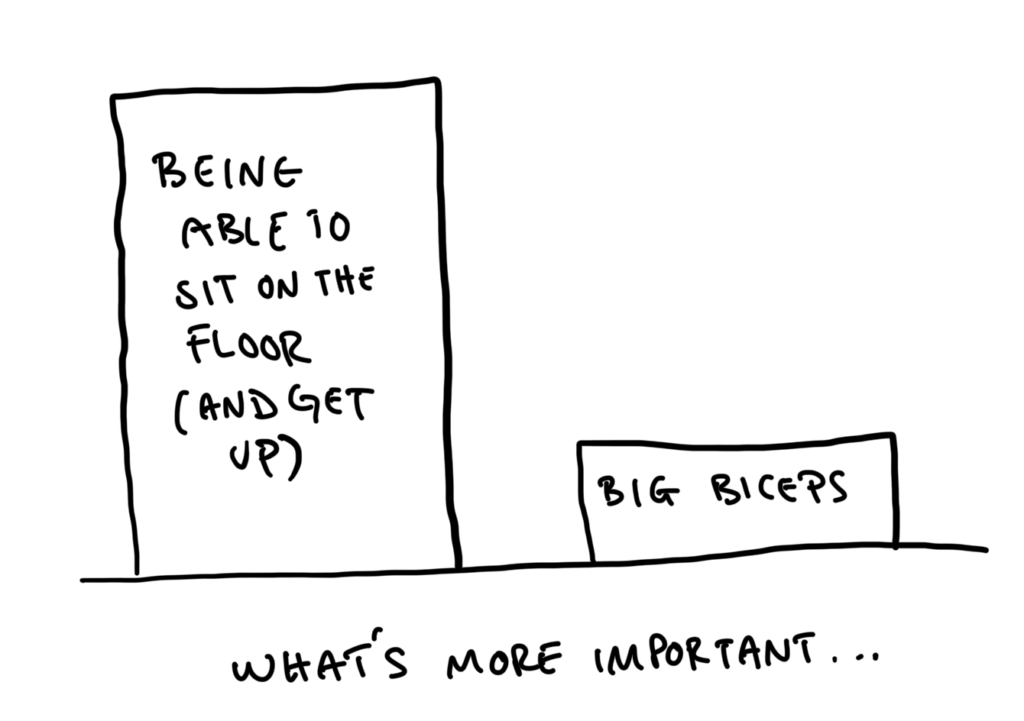
But he’s stiff, immobile.
He’s spent decades beating his body up, lifting, and lifting more. Now he can’t move.
He can’t walk very far. He can’t hike. He can’t (and won’t) do yoga. He can’t surf or paddleboard or ski.
But he can do bicep curls.
So that’s what he does. Every week.
He looks something like this (my fancy AI rendition):
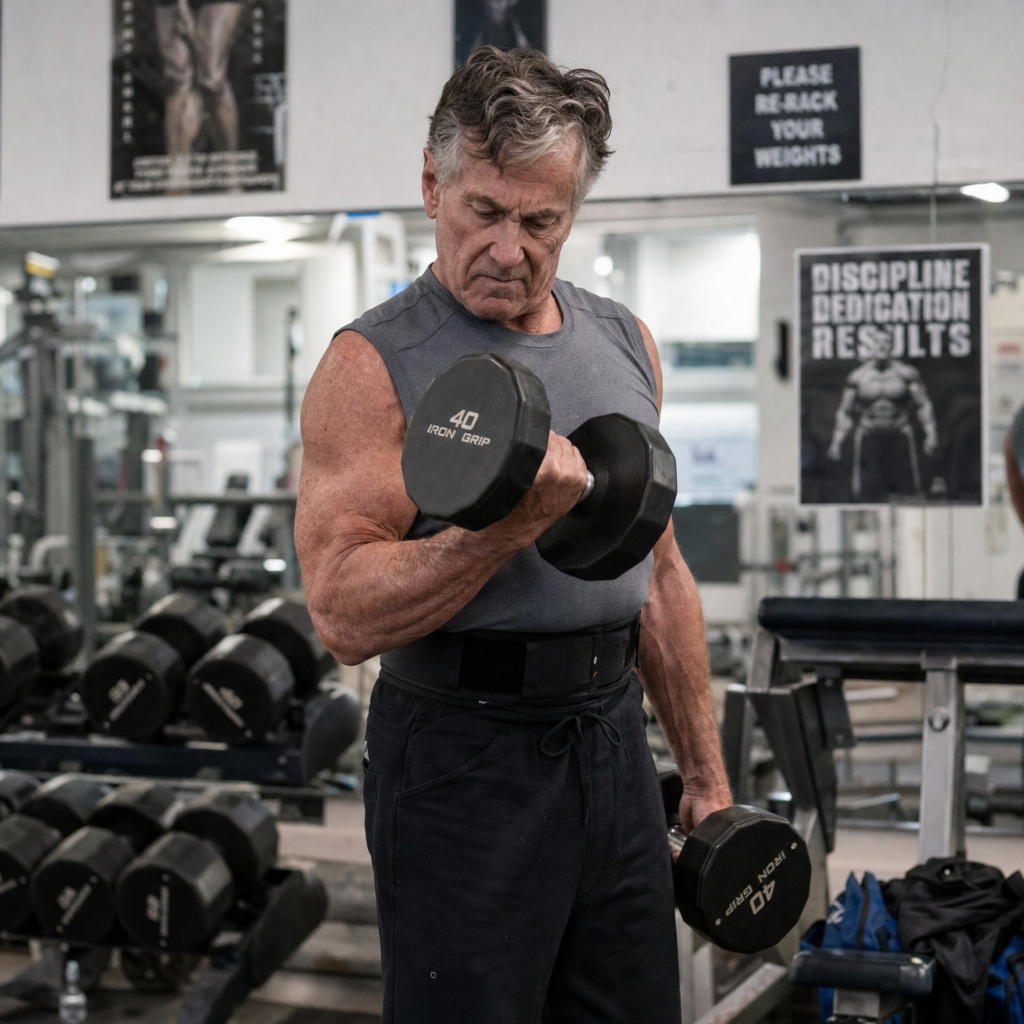
An “anti-goal”
I don’t want that to be me.
I’ve had knee pain for 14 years now, ever since I did a crazy amount of vertical jump training around 2012.
I’ve tried 50+ modalities to fix it.
I’ve made lots of progress. I can wakesurf. I can surf. I can ski. I can hike.
But not as much as I want.
30 years from now, I don’t want to be that old guy at the gym doing curls.
I want to be like Laird Hamilton or his buddy and mentor, Don Wildman. Surfing big waves at 60+. Going on adventures. Enjoying nature and physical exertion.
What I’ve learned so far about movement and mobility
I’m in the early stages of this journey to learn to move better so I can enjoy a pain-free, physically stimulating, and free life for many more decades.
I’ve talked with a half dozen top physical therapists across the United States, read dozens of books on movement, tried and used dozens of mobility tools, and beat up one mobility textbook so much that it started to fall apart (I switched to the Kindle version).
Here are a few things I’ve learned:
- Our bodies need to move. “Use it or lose it” very much applies. Sitting down for hours and hours is not good if we want to be able to move well long-term.
- Our bodies need a wide variety of movement. (This is the biggest lesson I took from Laird Hamilton, the 60+ year old that’s still surfing 50+-foot waves.) The opposite of this is lifting weights as your sole form of workout, especially the same exercises. Do a wide variety of exercises. Swim. Surf. Ski. Snowboard. Run. Sprint. Hike. Cycle. Do yoga. Do pilates. Paddleboard. Play pickleball. Play tennis. Do whatever you enjoy. The more variety the better.
- We can move more in daily life. Sit on the floor, not on the couch, while watching TV. Stand or walk on a treadmill while at your computer. Talk on the phone while walking, not on the computer while stuck at a desk Zooming. The book Built to Move by Kelly Starrett and Juliet Starrett gives some great tips.
- Healthy joints require movement. Motion stimulates the production of synovial fluid which helps lubricate, feeds nutrients to, and takes waste away from the joints. The trick, as I’ve found with my knee pain issues, is you need to experiment with the right type, intensity, and volume of exercise to nourish your joints without overly irritating or doing damage to your joints. (One way to know if you’ve pushed an exercise too hard for your current capacity is if your joint(s) still hurt the next morning.)
- Diet matters. First, being overweight is a recipe for a more likely early death and lower quality of life. Second, depending on your own biology, certain foods might cause inflammation making all movement more painful. (For me, I need to avoid starchy foods for 80% of my meals.) A simple rule that will solve a lot of health problems for 99% of people: Eat real food. Don’t buy it or eat it if it comes in a package or box. (If it does come in a package or box, make sure you’re 100% knowledgeable of and comfortable with ingesting every ingredient listed.)
- The best time to start was 10 years ago; the second best time to start is today. It doesn’t matter if you’re 20, 40, or 80, the best time to start applying the above 5 principles is now. Move more, in as many ways as possible. Move constantly. Move healthfully for your current capacity. But move! And eat well.
Money or and health
Most people treat health like it’s the price you pay to be successful.
Health, in my view, is both the fruit and seed of success.
As a healthy person, you’ll have more energy, feel better, be less sick, be happier, and look better- all scientifically proven to contribute to greater success, even in making money.
With financial success, it makes little sense to grind, hustle, and throw your health away in pursuit of something — more money — that has guaranteed diminishing utility. (If you’re already worth $X million(s), another million won’t make you any happier.)
What will improve the quality of your life is improving the quality of your health, including your ability to move and be the dynamic, physically active, and mobile human being you were meant to be, at almost any age.
If you’re already wealthy, an extra 20% mobility is worth a lot more than an extra 20% net worth.
Alright, that’s probably enough of my amateur ranting about health and fitness. Let me share a few resources with you from people who actually know what they’re talking about.
A few helpful resources
- Dan Go. He’s a friend, health expert with a crazy volume of content published, and a truly great guy. He lives this stuff too. He’s healthy, natural, and in great shape and doing the activities he loves like surfing in his mid-forties.
- Dr. Aaron Horschig (create of Squat University). He’s a licensed physical therapist that wrote the book Rebuilding Milo (highly recommended). I did a few 1:1 in-person sessions with him in Missouri. Great guy. Highly knowledgeable and down-to-earth.
- Kelly Starrett. It was his mobility book, Becoming a Supple Leopard, that I literally tore through using and had to switch to the Kindle version. Great resource on movement and mobility practices and wisdom. (Also recommend his book Built to Move.)
- Kellen Milad. This one is a bit random. I don’t think he’s that well known, at least not as well as the three above. But I’m a huge fan of his guided mobility practices on YouTube. For free, you can have him walk you through 20-30 min+ mobility practices. These are great for giving you quick doses of natural, highly varied movements.
To the next 30 years,
Matt