

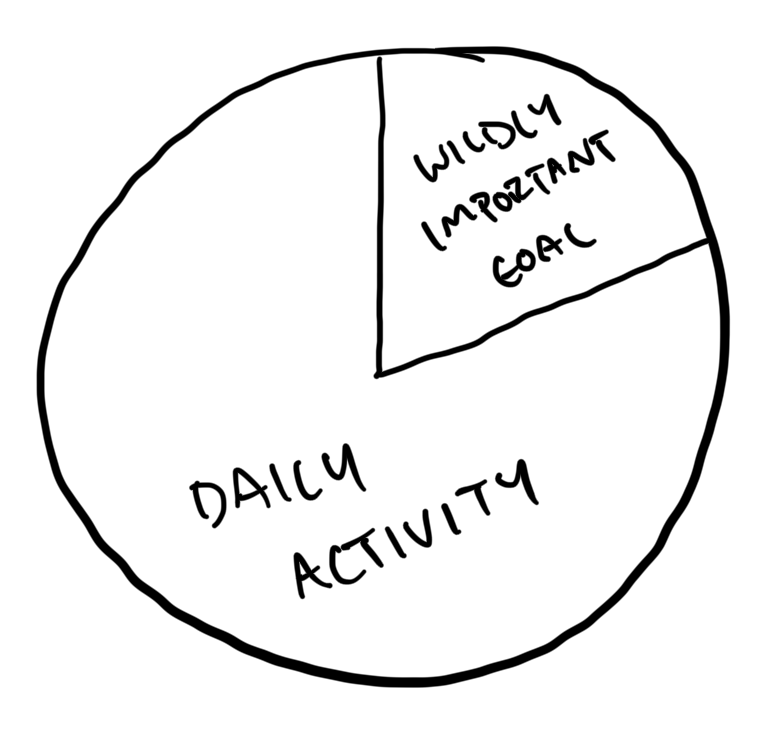
Here’s the “Wildly Important Goal” for the Lifeboost Coffee paid ads team: sell 100 units per day profitably of Mindflow.
We’ve struggled to sell this product with paid ads. We sold 2,000+ units with a few emails, so people want it (or, at least, are willing to try it). It gets good reviews. But ads haven’t worked so far.
Competitors selling similar — we think, inferior — products produce hundreds of millions of dollars per year in revenue.
It’s time to figure this out.
One goal
First, we need one goal.
A priority means one. If there’s no one, there is no priority.
Choosing one is painful. It’s much easier to hedge your bets and say you’ll accomplish six things, while knowing you’re just too scared to commit to one.
You might fail.
Good.
A chance of failure means the goal was big enough. With no chance of failure, the goal was too small. Small goals don’t change behavior, and changing behavior is the whole point of a goal.
A Wildly Important Goal: Beyond normal activities
I’m using The 4 Disciplines of Execution by Chris McChesney, Sean Covey, and Jim Huling as a guide. In this book, they talk about the “whirlwind”, the normal, chaotic, daily activities we all have in our jobs. That’s the activity that keeps the lights on and must be done.
A“Wildly Important Goal” (WIG), as the authors call it, goes beyond the whirlwind. Here’s how they describe it:
“Your WIG is an outcome so significant that it cannot be accomplished without the finest efforts of your team and by performance that is above their day-to-day level.”
They also caution against setting a goal related to what you’re already good at, the normal activities of your daily whirlwind.
For Lifeboost, I originally planned to set a goal to acquire more new Shopify customers. But we’re already doing that either way. It’s part of our daily activities. To achieve a big breakthrough, we need to figure out how to profitably sell our new product, Mindflow, with paid ads.
I deliberately set this goal low: only 100 units per day. At around $30 per bag, that’s $3,000 per day, or less than 2% of our $150,000 to $200,000 in daily sales. But I didn’t want to set a goal so big it demotivated the team — they all know we’ve struggled to sell this product with ads so far. But I know that if we can profitably sell 100 units per day, we can easily scale that to 1,000 units per day.
Tracked frequently
I’ve struggled to gain weight. I know, I know, no sympathy here.
When I trained jiu-jitsu four times per week, I wanted to get bigger to more easily hold my own again against 220- 250-pound monsters like Big Mike.
I set a goal. I committed to it. I lifted heavier. I ate more, or so I thought.
Nothing.
It wasn’t until I placed a bathroom scale in my home office and a whiteboard to track my weight on the wall above it that I made progress.
I weighed myself every single day. Within a week, I’d gained two pounds. Then I kept gaining more weight.
Measuring my progress provided me a daily reminder of my goal. I then did what I needed to do — mainly eating even more — to improve the measurement I tracked.
For our Wildly Important Goal, we must track it at least every week and review it together during the first few minutes of our weekly paid ads team meeting.
Buy-in from everyone involved
I recently created a one-page financial plan for our family with my wife. Had I done that exercise on my own, 1) it wouldn’t have been as good (my wife is a smart cookie who helped make it better) and 2) it wouldn’t have had as much power to help us make decisions because she wouldn’t have been bought in.
Setting goals on your own, behind a closed door, is easy. You just think of something, maybe write it down, and you’re done.
But goals set in isolation are weak.
You have no commitment. No pressure to perform. No buy-in from others involved.
I can’t set a goal for our company’s paid ads team by myself. I’ve spent hours thinking through it, so I’m pretty clear on what I think it should be. But this goal means nothing until I explain it to, hear any counterarguments against it from, and, if all goes well, get buy-in from the other stakeholders. That means discussing this goal with Charles, my co-founder, and the other members of the paid ads team.
I’ll let you know how it goes this week.
—Matt