

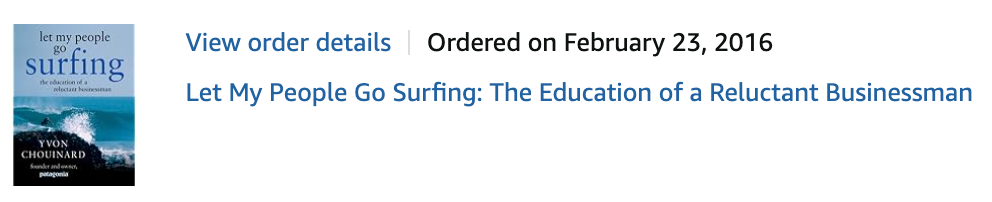
I ordered this book as my company melted down:
I successfully turned a $32 million per year business into a $9 million per year business, burning $500,000 in cash per month.
Two months later, I fired half the company via email.
How to build a business you’re proud of
I couldn’t take it anymore.
We built Amazing.com based on big promises that anyone could build a successful ecommerce business.
And it worked.
We sold a lot of course memberships, and lots of customers achieved huge success.
But I grew uncomfortable with the overpromising, inflated expectations, and aggressive affiliates promoting our course for thousands of dollars per signup.
I didn’t yet know how to sell what we did in a way I was proud of, so I did the only thing I could think of:
I reduced the price of our product from $5,000 to $39 per month.
At a much lower price, I thought, we wouldn’t have to sell so hard, and we could help a lot of people.
That strategy didn’t work.
The type of people willing to pay $5,000 for an 8-week step-by-step program are far different than those who buy $39/month memberships.
We also couldn’t afford to provide people paying $39/month with the level of one-on-one attention and resources they needed to build successful businesses.
Why I admire Patagonia and its Founder, Yvon Chouinard
Chouinard was a rock climber who started making climbing gear during the offseason.
And people couldn’t stop buying it because it was the highest quality gear available.
A side hustle turned into a large company, initially built by him and his climbing buddies.
As the company grew, Chouinard realized that Patagonia could be a platform for good, not just a profitable business.
He’s worked hard to create the most sustainable products possible, to be honest about Patagonia’s impact on the environment, and to support causes that affect the planet.
Chouinard built a company with $1.5 billion in annual sales not despite its values, but because of them.
How most of us sell
Most of us sell — do marketing — by appealing to the basic needs of people, the bottom layers of Maslow’s Hierarchy:
- Physiological needs (food, water, shelter, clothing, sleep)
- Safety and security (health, money, family, social ability)
- Love and belonging (friendship, intimacy, connection)
- Self-esteem (confidence, achievement, respect)
In marketing, we use this process to appeal to those needs:
- Point out that people have a big problem in one of those areas (e.g., “Your safety is at risk because there’s a war in Iran.” or “You might lose your job soon because the economy is fragile.”)
- “Amplify” that pain to make people even more scared or anxious about their problem
- Explain that the only possible way for people to eliminate their pain is by purchasing our product
It works.
I’ve used it to sell educational products, services, masterminds, supplements, and coffee.
Others use it to sell thousands of consumer products, self-development programs, books, investments, and votes for politicians.
The problem with this form of marketing is not that it doesn’t make money; it’s that it ruins your soul.
A better way to sell
In the book Winning the Story Wars, author Jonah Sachs points out that Maslow also listed a collection of higher-level needs, called growth needs. These include:
- Wholeness
- Perfection
- Justice
- Richness
- Simplicity
- Beauty
- Truth
- Uniqueness
- Playfulness
Our goal as humans is to elevate ourselves and others beyond basic, survival-oriented needs to higher, growth-oriented needs.
Many of the best companies in the world have figured this out. Whether you agree with all their products and practices or not, these brands use aspirational values to produce effective marketing:
- Nike inspires us to do more and be more
- Coca-Cola spreads joy
- GEICO uses humor and playfulness to sell insurance
- Patagonia inspires us to be more conscious of our impact on the environment
I’ve admired the uplifting message in marketing campaigns for many brands such as these for more than a decade. Yet, it wasn’t until just recently that I better understood how to apply what they were doing rather than just using common fear-based tactics to sell.
I feel a bit like Neo in The Matrix. I’ve just taken the red pill. I can’t unsee what I believe is a better, more admirable, more profitable way to sell.
Now I just have to apply this process in my own businesses.
Here’s a starting plan:
- Clarify the values we most want to promote and live up to (Sachs of Winning the Story Wars recommends choosing a maximum of 3)
- Mine our backgrounds, our day-to-day experiences, and the experiences of our customers for examples of living up to — or not living up to — those values
- Use those stories as raw material for powerful marketing messages to inspire others
As an example of how inspirational stories turn into iconic and effective marketing campaigns, check out Nike’s 1988 “Just Do It” ad. It’s literally just a short story of an 80-year-old named Walt jogging across the Golden Gate Bridge. That message is still spreading 38 years later.
I’m in the trenches with you on this, but now is the time.
—Matt