

When should you use AI?
For fewer tasks than you might think.
I’ve been working on a tool I’m calling The AI Delegation Framework.
The goal is to help us decide when (and when not to) use AI.
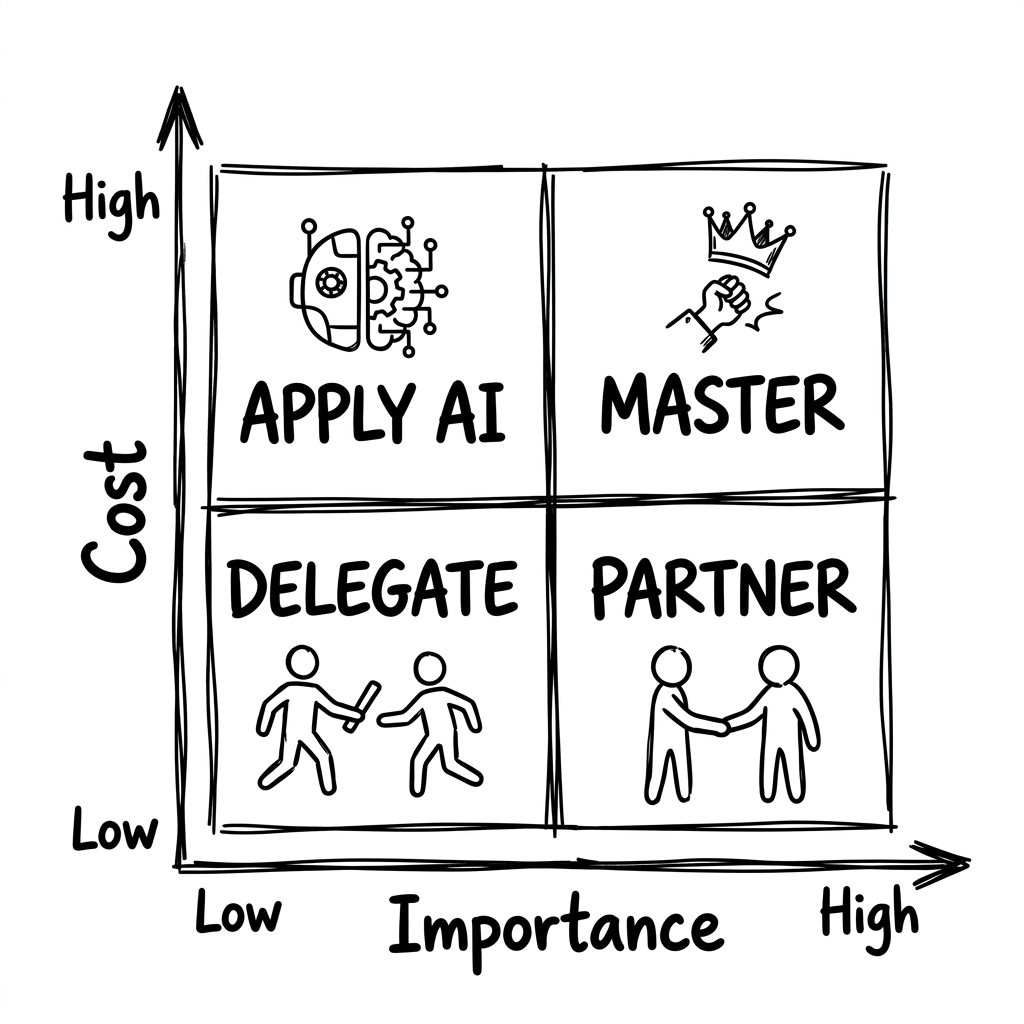
Two variables
1 – Importance to your long-term development
First, determine if the task is something important to your long-term development.
If you want to be a great sales copywriter, then building that skill is high on this variable. If you have zero interest in getting better at writing copy and just want that task done, then that skill is low on this variable.
Here are examples of low importance to my long-term development from my recent two-week time audit:
- Sales calls
- Paid advertising management
- Content scheduling
- House and boat maintenance
- Prepping meals
- Slack, email, WhatsApp, text messaging
Here are high-importance items:
- Writing email newsletters
- YouTube content planning
- Team calls
- Exercise
- Family time
The key is to decide whether this is something you want to get better at or just want done.
2 – Cost
Next, what’s the cost to have someone or something (such as an existing software tool) do it as well as you?
If it’s less than $100 an hour, I consider it “low” cost. If it’s greater than $100 an hour, I consider it “high” cost.
This isn’t really about how much you earn per hour; it’s more about the general, objective cost to get the task completed.
Examples of low-cost tasks:
- Content editing
- Taking dog to groomers & daycare
- House and boat maintenance
- Prepping meals
- Social media posting
High-cost tasks:
- Finance
- Sales calls
- Paid ads management
- Product development
- Team calls
- YouTube strategy
The four categories
Determining how important a task is to your long-term development and its cost to get it done, as well as how you could do it, results in it ending up in one of four categories:
Partner: High importance, low cost
If a task is important to your long-term development, yet it is low-cost to have someone else do it as well as you could, partner with someone else to get it done.
For example, exercise. You could read a dozen books on exercise and healthy eating, or you could pay a trainer or coach $30-$50 an hour to work out with you and give you a diet plan. Your health is important to your long-term development, but learning a lot about health is inexpensive if you outsource decades of knowledge to someone else.
As another example for me, YouTube planning and performance review. I personally want to get better at YouTube, but I can pay someone else to help me with data gathering and research. So, I’m hiring a full-time Creative Director soon.
Master: High importance, high cost
I want to get better at developing products for my businesses, and it’s expensive to hire someone who can do it well ($200K-$500K per year), so I focus on mastering this task myself.
I want to get better at writing, scripting, and delivering YouTube content. It would be expensive to hire someone with my expertise to replace me, so I’m focusing on mastering these skills.
Once you remove, delegate, or outsource everything else, these are the tasks you devote years to improving at.
Delegate: Low importance, low cost
I don’t want to get better at content scheduling, content editing, email management, lead generation, or meal prep, and since getting someone else to do those tasks is relatively inexpensive, I delegate them completely to other people.
This is currently the biggest trap for people using AI. They spend hours, days even, tinkering with their Claude bot to get something done that they can pay a person or software business a few hundred dollars to do for them.
Apply AI: Low importance, high cost
We’re finally left with the last group of tasks for which it does make sense to apply AI.
You don’t want to get better at these tasks long-term, but they’re relatively expensive to get done as well as you could do them.
If you’d have to pay quite a bit of money to have a person or business do these for you, it makes sense to look for ways to reduce the cost of getting them done with AI.
For example, paid ads management. I am not that confident that I can get AI to completely manage paid advertising on any platform today; however, I can use AI to create better ads, making paid advertising more effective (and cheaper).
As another example, writing good sales copy. At this point, I don’t really care to get any better at writing sales copy, and good human copywriters are expensive divas, so it makes sense to tinker with AI to get it to generate better copy.
What do you think?
This model is a work-in-progress.
I’d love to hear what you think.
Specifically, give this model a try with one or more tasks you’re deciding how to get done, then tell me whether you find this framework useful or confusing.
I want to make it better and more useful.
Join my newsletter below and send a reply to the first email if you apply it.
Thanks,
Matt