

Is the agency you already have (or the one you’re thinking about hiring) any good?
Most aren’t, but some are.
I’ve made a lot of money with great agencies; I’ve lost a lot of money with bad agencies.
Below is a filter you can use to evaluate your current agencies and any new ones you consider working with.
By applying “The Great Agency Filter” (my fancy new term), you’ll get better results working with agencies in all areas of business.
The Great Agency Filter
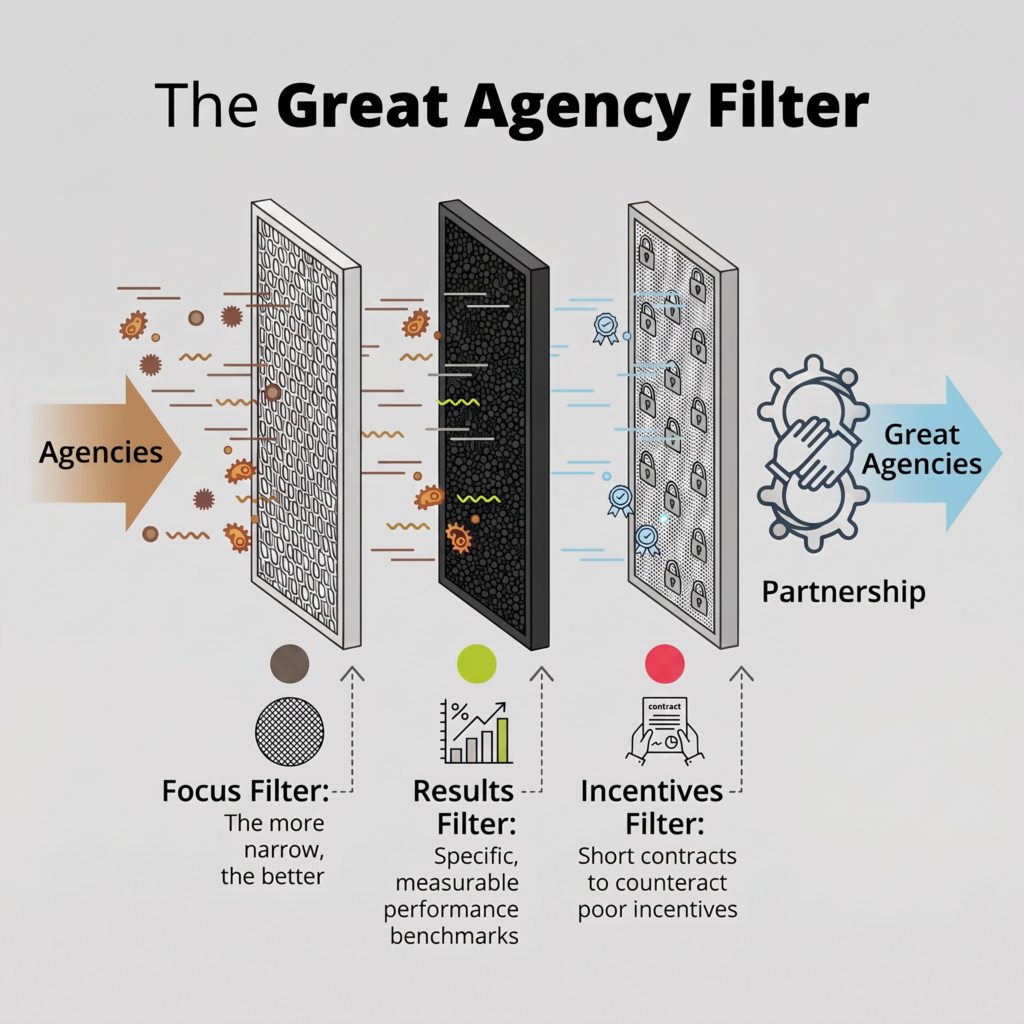
Filtering agencies is like filtering air. Many agencies, ones wanting to work with you and those who already work with you, want your money. Your goal is to filter all the possible agencies so only the great ones, the ones you partner with long-term, make it through.
Apply this framework to both new agencies that reach out to you or that you consider working with and to your existing agencies.
The Focus Filter
The best agencies are the most specialized.
Agencies that claim they’ll do a great job with your email marketing, Facebook ads, SMS campaigns, website optimization, and Google ads (plus anything else you’ll let them earn a fee on) are typically mediocre, at best, at everything they offer.
A great agency specializes in one or maybe two areas at most.
The best advertising I’ve ever worked with only managed Meta advertising. They wouldn’t manage Google, TikTok, or any other hot new platform.
For any agency, ask them what they’re best at. Then only hire them for that one area of your business. Avoid the temptation and their repeated requests to take over more areas of your business for additional compensation.
The Results Filter
One benefit of making an agency only responsible for one area is that it’s much easier to hold them accountable for results. If they’re responsible for multiple areas and your overall business is growing or declining, they’ll blame outside forces for bad performance and will take credit for good performance.
Hold them accountable. That starts with knowing the specific results you expect them to produce.
If it’s an area of your business that you know well based on past experience, clarify exactly what results you expect them to produce in that area and by when.
If it’s an area of your business you don’t know well, then ask others you know and respect outside your business what specific results the agency should produce in that area.
For example, I am working with an 8-figure brand that dominates its categories on Amazon. They want to expand their Shopify sales. First, I said, before adding new funnels and traffic, let’s squeeze more results from what you’re already producing on Shopify.
They have an agency doing many things, including managing their email marketing. They’re getting good open rates and OK click-through rates, but terrible placed-order rates and revenue-per-recipient results.
However, they had no idea what performance to expect in those areas.
Based on your own experience or by asking for outside help, know the exact results you expect the agency to produce and hold them accountable.
The Incentives Filter
It’s unlikely you’re going to reinvent agency incentives.
In most cases, an agency is paid a minimum fixed fee plus a percentage of something else, such as ad spend, when managing paid ads.
The problem with that structure is that many bad agencies will focus primarily on collecting the minimum fee. Instead of optimizing their results, they spend 90% of their time hunting down new clients to collect more minimum fees.
The more aggressive agencies will spend your money like it’s not theirs (because it’s not) just to increase their total fees.
Understand what behavior the agency’s incentive structure is likely to encourage.
One way to counteract bad but common agency incentive structures is to use short-term contracts. If the agency knows you can replace them every 30 to 90 days, they’ll work harder to keep your business by producing better results.
Partnership
Once an agency has made it through the three filters, it’s now up to you to create a good long-term partnership.
Ask the agency, “What do you need from us to do your best job?”
Then give them that.
Also, as with any good partnership, regularly check in with the agency on results versus expectations and discuss how you can work together more effectively.
I recommend meeting with most agencies to review results at least weekly. Compare the results they’ve produced versus the specific results they should be producing.
Don’t let them make excuses for poor performance. As long as you’re providing them with what they said they need, hold them accountable for excellent performance.
$200M+ with agencies
We’ve sold over $200M in our e-commerce business so far. We produced much of our growth by partnering with agencies.
As compared to hiring only full-time employees, you can often find more capable people at a cheaper overall cost because they’re only working fractionally for your business through hiring agencies.
Apply the Great Agency Filter to avoid many of our costly mistakes to grow your business faster, more easily, and more profitably.
—Matt