

A few years ago, I interviewed Chris, the owner of a $75 million supplement company, on stage before our group of 7-figure e-commerce business owners.
I’d just spent the morning explaining to our group that you should always direct traffic directly to in-depth sales pages. First, build desire with the headline, benefits, and features, then ask for the order toward the bottom of the page.
I ask Chris what landing pages he sends his traffic to, and he says, “We don’t. We send everyone straight to product pages.”
Whoops.
Product pages, as seen on Amazon, display order and pricing information at the top, with sales information below—precisely the opposite of my advice.
Chris exercised one of the essential principles of scaling funnels: remove all unnecessary steps.
Today, in our $50M+ business, Lifeboost Coffee, we still get better performance from sending people to carefully structured landing pages. As you’ll discover shortly, top direct-to-consumer brands use both product pages and landing pages. What matters most is to keep your funnel as simple as possible.
The Myth of the Mega Funnel
I remember sitting in the audience at a large marketing event where the hosts revealed the secret to their success. They showed a screenshot of a giant flowchart that depicted how leads entered their business and were guided through dozens of possible paths based on their actions. If they clicked this button, they’d be shown a sequence to sell that product; if they watched another video, they’d be shown a different product.
The audience members feverishly took notes.
A few years later, those hosts exited that business.
Every extra step you add to your sales funnel presents two risks:
- Something will break technically
- Potential customers will get annoyed and drop off before giving you money
A few years ago, I came across the Wild Alaskan Salmon & Seafood Company. At the top of their website, they featured a slick quiz-type funnel. They’d ask you a series of questions about what you’d like to buy and how much, then present you with a special offer tailored to your answers.
“Amazing,” I thought. “How could that not convert better than presenting the same offer to everyone?”
We tried it. It bombed.
(I also just checked Wild Alaskan’s site—the quiz funnel is gone.)
What’s worked for our e-commerce business has been relatively simple from the beginning. The only significant change we’ve made is to remove the cart step and direct users directly from the landing page to the checkout page.
The First Goal of Scaling Any Funnel
Your first and only goal when launching a funnel is to get orders flowing in.
You can’t increase conversion rate without conversions.
You can’t increase average order value without orders.
You can’t increase customer lifetime value without customers.
Two years ago, we created a funnel to grow our product selection software tool at Amazing. We modeled the funnel after the software funnel a friend created that scaled to 8-figures per year.
We focused 90% of our effort on the landing page. We spent only 10% of our time on the upsell pages. We also didn’t try to maximize our upfront price. Our goal was to drive customer purchases so we could optimize.
Sales came in immediately. At first, like always, conversions cost too much. That’s OK. Once sales were flowing in, we could test to increase the conversion rate. Later, we test to increase the average order value.
In less than two months, we scaled the funnel from zero to $4,000 per day.
Start with the simplest funnel possible. Remove all unnecessary steps.
Get customers to buy, so you have something to optimize.
Simple Funnels Win: An Analysis of 10 Top Direct-to-Consumer Sales Funnels
I used Facebook Ad Library to look at the sales funnels for these top direct-to-consumer brands:
- The Ridge
- Ryze
- True Classic
- AG1
- LMNT
- Cuts Clothing
- Caraway
- The Woobles
- Dr. Squatch
- Blume
The type of page they primarily send traffic to:
- Landing page: 60%
- Collections page: 30%
- Product page: 20%
Number of steps in their funnel:
- Two steps: 50%
- Three steps: 40%
- Four steps: 10%
- Five or more: 10%
*Note: For example, landing page → directly to checkout is a two-step funnel. I didn’t count checkout boxes that slide out on the page as a separate step; I only counted checkout as a separate step if you’re taken to a new page.
Nine out of ten of those top ecommerce brands have three steps or fewer in their sales funnels.
When launching any funnel, start with the fewest possible steps. Even if you’re selling something non-ecommerce, like a service, some of the highest-performing funnels I’ve seen in that space only involve a few steps.
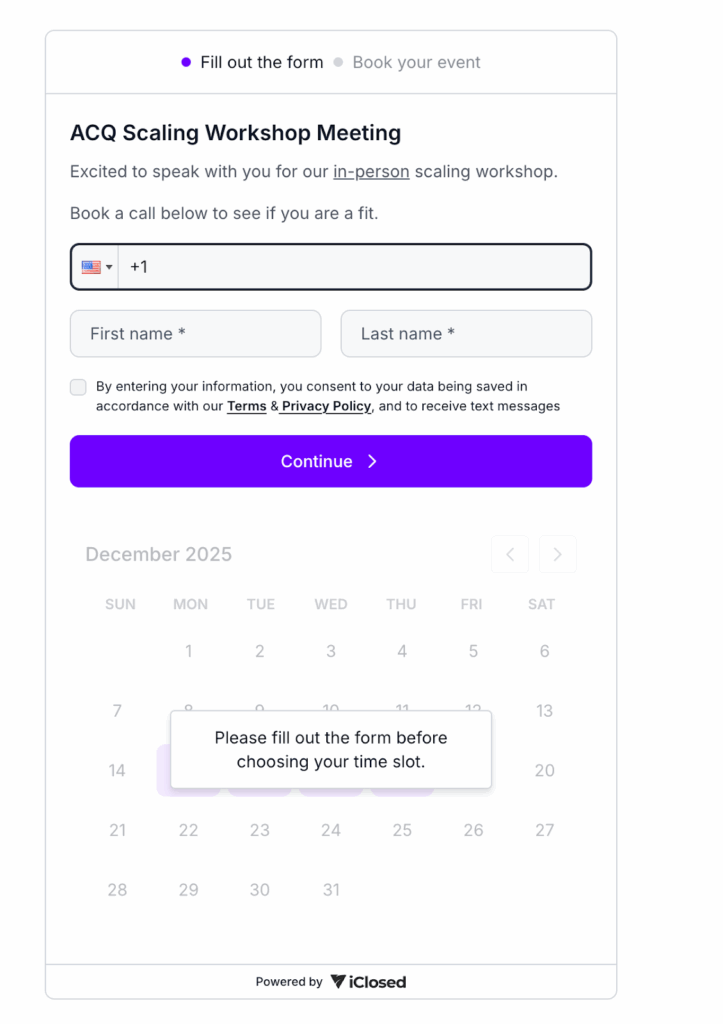
For example, Alex Hormozi’s funnel to sell his $5,000 live workshops, in which his sales team then offers $30,000+ coaching programs, is only one step. The sales call booking form is embedded at the bottom of the single page you land on after clicking his ad.
Summary: Orders, Then Optimization
Here’s the process to scale any funnel:
- Get orders flowing in
- Increase the conversion rate (more orders)
- Increase the average order value (more money upfront)
- Grow the lifetime value (more money later)
That four-step process can scale a funnel from zero to millions to tens of millions of dollars.
Join 80,000+ People Scaling Businesses
This article is the latest issue (as of the time of writing) of my 100% free newsletter, the Scaling Journal. I share exactly how I’m growing my businesses, which have around $100M in annual sales. You’ll get detailed strategies to scale your own company as fast as possible so you can live the life you really want.
I publish new issues every Tuesday and Friday. Subscribe for free below.