

Imagine you’re a gambling addict.
You know you need to stay out of casinos.
There’s just one problem: you also love coffee, and the only coffee shop in your town is inside a casino. (And you really prefer to get out of your house to grab coffee.)
Every time you want an afternoon pick-me-up, you hear the irresistible cha-ching! and buzzers of hundreds of slot machines.
Using the internet to be productive is like visiting a casino to grab coffee.
Taking my productivity offline: The paper planner
Three months ago, I listened to a podcast episode with a woman who is a mother of four, a medical doctor, and a marathon runner.
(Hot tip: If you want productivity advice, ask the mom of four, not the 23-year-old YouTube bro who is barely out of his mom’s basement and only wears black shirts to reduce “decision fatigue”.)
She mentioned doing all of her planning and calendar-keeping offline on paper.
I decided to give it a try.
I bought the Hobonichi Techo 2026 Cousin Book for $65 on Amazon.
This little book includes yearly, monthly, weekly, and daily views. Though it has a full 8” x 6” page for every day, it easily fits in a backpack thanks to its very thin paper.
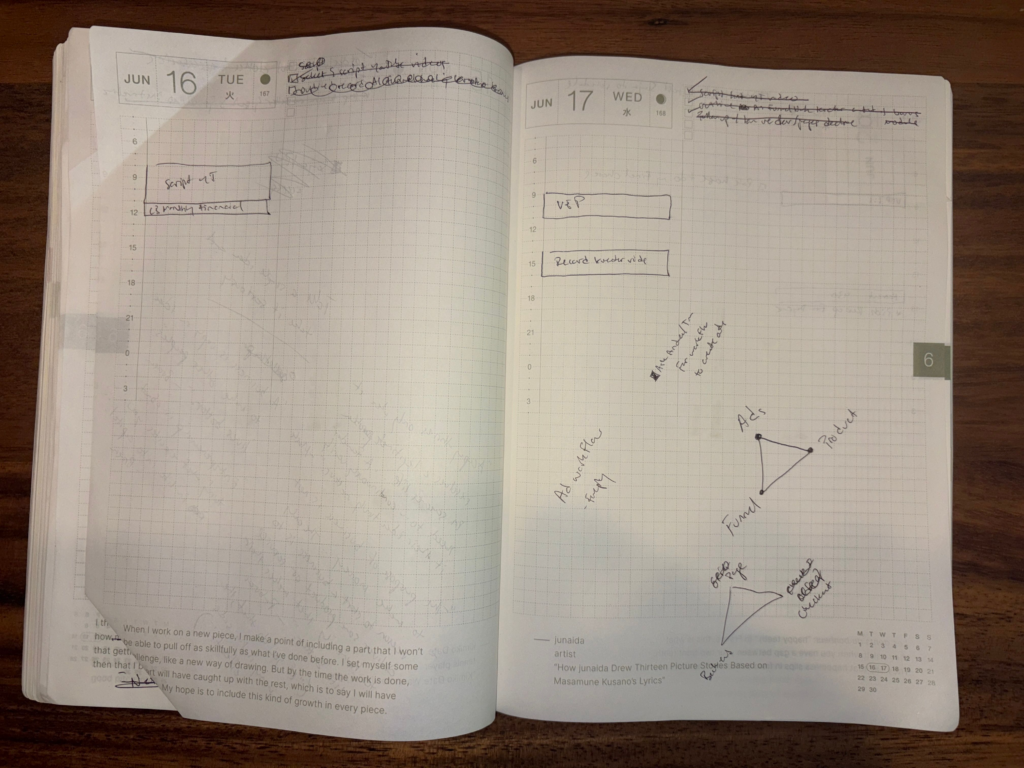
Replacing Google Calendar?
My initial aim was to fully replace my Google Calendar with my paper planner. But I quickly realized that’s not easy—or what I really wanted.
Google Calendar makes it too easy to create joint calendar events with my business partners and external partners. It automatically creates unique Google Meet invites, which saves time adding/scheduling Zooms.
Plus, when I want to meet with someone else, I want a reminder in their calendar, not just mine, so I don’t waste time showing up to meetings people forgot about.
How I use my paper planner for greater focus, better offline thinking, and staying on track with my bigger goals
- I wrote my annual goals for the major areas of my life on one of the semi-hard cover pages at the front of the planner
- At the beginning of a “season” (mine are Spring Hustle, Hot Season, Fall Sprint, and Holidays), I write down my goals for that season pulled from my bigger annual goals
- At the beginning of a month, I write down my monthly goals pulled from my season goals
- At the end of each week, I pull a high-level overview of my Google Calendar entries into my weekly planner view. I then plan the week and weekend ahead offline. I plan my weekly priorities based on my monthly goals.
- Each day, I write down my 3-5 highest priorities, pulled from my weekly priorities. I also write down my major appointments so I know where I have time for non-meeting focus work.
Goals in my planner cascade as follows: Year —> Season —> Month —> Weekly priorities —> Daily actions
Stay out of the casino
The internet is too distracting for me.
I go to research some small thing for a goal I’m pursuing, and before too long, I’m down an email rabbit hole or hitting refresh on my YouTube Studio stats twenty times.
Some of the smartest people in the world work hard every day to pull your attention from what matters most to what makes them the most money.
Reclaim a piece of your life with a little less time online.
—Matt