

“I’m thinking about starting something different,” he said.
“Uh oh,” I thought.
I was at a private mastermind, and my friend, an owner of an 8-figure consumer products brand, shared that he was getting frustrated with his current business and thought starting something new would help him make more money.
After helping people start and grow businesses for 14 years, I’ve seen this instinct in others and myself many times.
The shiny object never loses its appeal.
Our natural instincts get in the way of us making the best, most rational decisions. We must counter them to grow our businesses as efficiently as possible.
Where to focus, part 3 of 3
This is the final part of the 3-part series on using the Core-More-Explore Framework to determine exactly where to focus resources in our businesses. (Here are links to Part 1 and Part 2.)
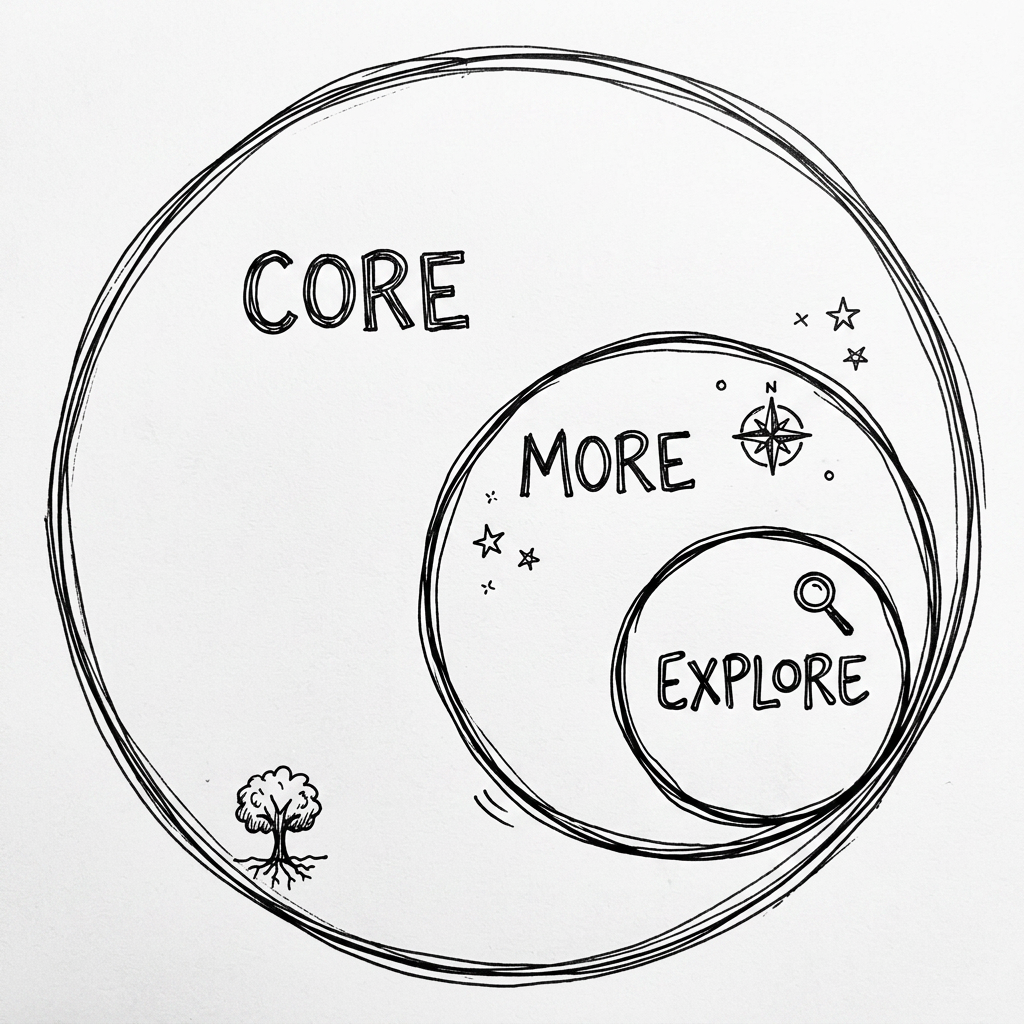
This model tells us that the majority of our resources (70%) should go toward protecting the Core of our business’s operations, the main products, channels, and people that drive the majority of revenue and profits. The next-largest share of our resources (25%) should go toward investing more in the areas of our business with proven traction (“More”). Lastly, a small portion of our resources (5%) should be invested in exploring new potential growth opportunities (”Explore”).
But that’s not how we instinctually spend our time, energy, and attention.
We’re wired to survive, not to invest intelligently
Wikipedia lists over 200 cognitive biases. These are mental rules of thumb we apply based on our thousands of years of trying to survive as individuals and a species.
These mental rules of thumb usually work pretty well (that’s why our ancestors were successful enough to let me write this and you read it).
However, in decisions requiring judgment of long-term consequences, such as those related to growing a business, many cognitive biases get us into great trouble.
For example, I knew my friend’s business had historically been a great cash-gushing machine that had recently had a few issues. Most of those issues were caused by overexpansion during a boom time (his business is quite cyclical) and a resulting poor profit performance during a market contraction (expenses were too high relative to lower revenue).
Comparing the current, lower performance to a previous, much higher performance in terms of revenue and profit was hard. So, he thought, it would be much better to start something new, with no base to compare its performance to, than to face the hard reality that his business would not always be better than it was the year before.
Here are a few cognitive biases that affected his judgement and would do the same for all of us in his situation (some of these are common terms as you’d find on Wikipedia, others are from Charlie Munger’s “25 Causes of Human Misjudgement” talk):
Chasing the shiny object:
- Curiosity (”What’s over there?”)
- Overoptimism (”This new businesss will for sure be great.”)
- Excessive self-regard (”I’ve been successful at my old business, so starting anything new will be easy.”)
Avoiding fixing a great, but recently struggling, business:
- Contract misreaction (”My business has declined, so I don’t want to work on it anymore.”)
- Availability bias (”Recent poor performance will continue forever.”)
- Doubt-avoidance (”I don’t know how to fix my business, so I’ll just avoid it.”)
- Envy/jealousy (”Other people’s businesses in different markets are booming right now, so I’ll just go into the same market.”)
- Inconsistency avoidance (”I’ve told people about the great success of my business, and now I have to tell people about its decline.”)
The cost of mis-investing
Investing in the wrong area, whether inside or outside your business, can produce catastrophic results.
If you invest in a new, exploratory opportunity, while the Core of your business needs fixing, the result in most cases will be a much smaller overall business that takes great effort, time, and money to revive.
Invest correctly by recognizing the 6 most common business focus decision errors
Using the Core-More-Explore Framework as a guide, the following are the six most common errors we make as leaders of companies with regard to how to invest to grow our businesses:
1 – Core is boring, Explore is exciting
We get bored doing the same thing year after year. That doesn’t mean it is any less important.
2 – Core is hard, Explore is easy
New opportunities always seem easier than the problem we know (the Core of our business). Most new opportunities, once you become familiar with them, are no easier than what’s created all your success up to this point.
Once you get to the other side, the grass often looks greener back on your original side.
3 – Core is comfortable, Explore is scary
On the other hand, some of us often don’t want to explore. We know our Core and keep hammering away at it, often for too long. We need to explore. It’s uncomfortable and likely won’t work most of the time, but it’s the only way to ensure our long-term survival.
4 – I don’t have the time/money to invest in new stuff
You likely had less time and less money than you do now when you started your business, but you did it anyway, right?
Like brushing your teeth, you don’t have to spend all your time investing in exploratory opportunities, but you need to spend some time.
5 – My team is taking care of the Core stuff
As long as you’re an owner, the Core is your responsibility. It doesn’t matter how many people you have working for you; much of your net worth is dependent on the Core of your business thriving. Even if you don’t run day-to-day operations, you must still carefully monitor the performance of and inputs to the Core of your company.
6 – I’m an entrepreneur
Mark Zuckerberg renamed his trillion-dollar company after becoming infatuated with virtual reality and the metaverse. His company’s value declined by over 70%. To his credit, he did an about-face and refocused his company on what it does best: selling ads.
As an entrepreneur, you like to explore. Do it. Just don’t be the whole company on pursuits with a high likelihood of failure.
When expanding to a new channel, don’t forget the one that’s built your business
I’m coaching 7- and 8-figure Amazon sellers on how to scale on Shopify. At least once a month, however, I ask each one, “How’s Amazon?”
Adding Shopify as a sales channel will diversify their businesses, greatly increase their companies’ value, and eventually generate more sales than they do on Amazon. However, none of that is possible if they neglect the Core of their business today, Amazon.
Becoming more rational leaders
Just as we have to overcome the natural wiring that tells us to store calories by eating one too many bites of cheesecake, we also have to overcome our tendency to avoid boring stuff, seek novelty, and overinvest in unproven ideas.
You’ve likely learned to eat less cheesecake. You can also learn to overcome some of your mental rules of thumb, which cause misinvestments in business.
—Matt