

It’s much easier, much faster, and more profitable to grow a business when you pull the right lever. Most business owners yank and strain to force the wrong lever beyond its maximum utility. They’d be better off redirecting their energy.
Part 2 of the 3-part Core-More-Explore Framework series
In the previous newsletter, I introduced my Core-More-Explore model. Today, I’m going to break down exactly how to apply it to achieve your goals. This works whether you’re neck-deep in running a $10M+ business, just hit your first $1M, or are at the very beginning stages of your business journey.
The financial and time cost of pulling the wrong lever
Some business owners spend years, decades even, trying to force the few activities that have worked in the past to produce far more than they’re capable of producing in the future.
Just because something has worked doesn’t mean that it will work forever.
However, other business owners get so excited about new opportunities that they fail to protect and nurture their business’s core. Soon, they find themselves with many half-completed projects and a business in severe decline.
Exactly where to focus for the fastest growth
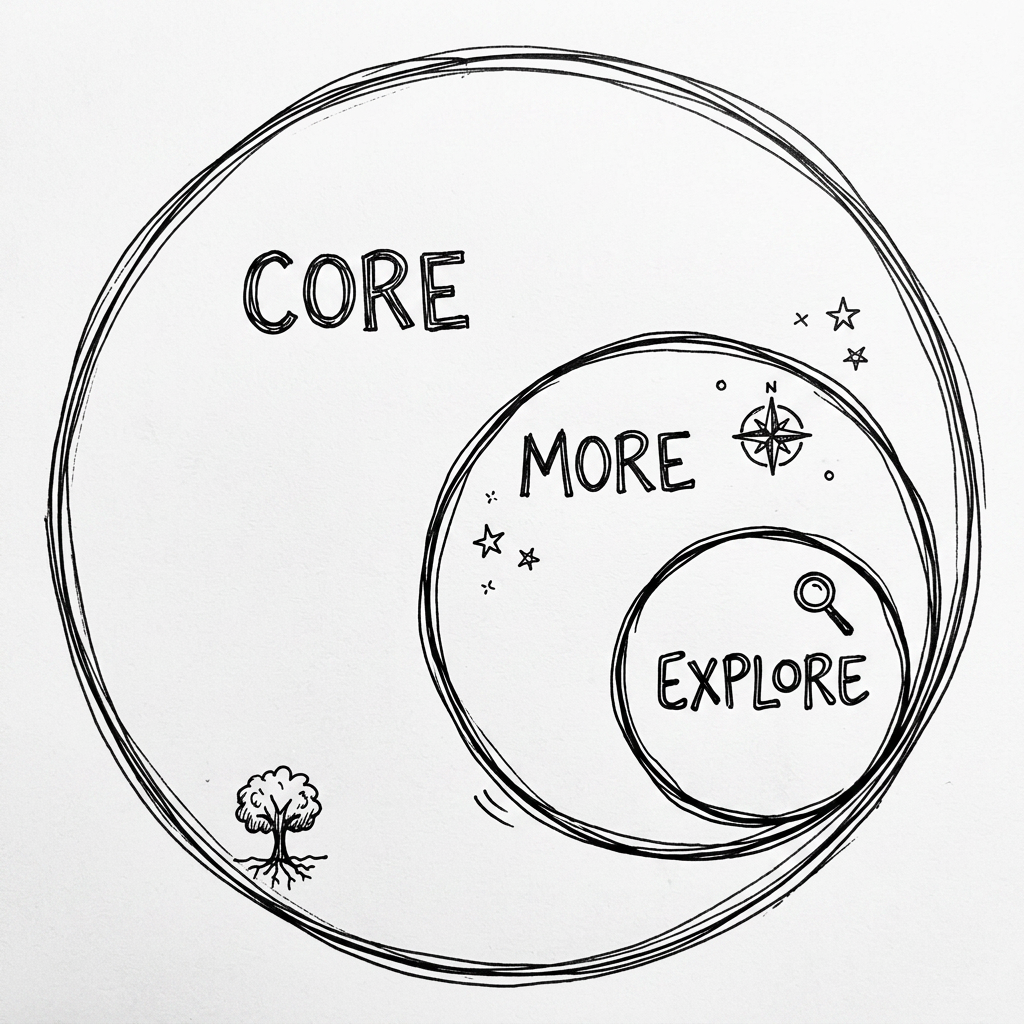
Apply the Core-More-Explore model to know exactly where to focus your energy and resources at any stage of your business journey.
Core (75%): The products, channels, and people that produce 70%+ of your business’s revenue and profits.
More (25%): The products, channels, and people that are growing and picking up traction. I call this “More” because the easiest way to grow a business is often to invest more in non-Core areas with proven traction.
Explore (5%): The completely new bets you place on what could transform your business in the future.
As a rule-of-thumb, devote 75% of your resources to Core, 25% to More, and 5% to Explore.
Here are three common scenarios and how to apply this model to determine where to focus.
Scenario 1: Secure, slow-growing Core
Reality: The Core of the business is protected, secure, and growing moderately. Further opportunities to reinvest to grow the Core are minimal. The business has some traction in More areas, and is running many Explore experiments.
Solution: Rather than investing in further Explore experiments, double down and invest in More activities with proven traction. Devote more time, money, and energy to growing areas that could become the business’s future Core.
Example: One ecommerce client I’m coaching owns an 8-figure business with 90%+ of its sales on Amazon. He dominates most of the markets he sells in. He has some traction on Shopify with a few products, ads, and funnels. My advice: Invest more in what’s working on Shopify to scale it rather than launching more products, channels, or funnels.
Scenario 2: Growing Core market, but declining business Core results
Reality: The Core market for the business is growing, but the other areas of the business are declining.
Solution: Rather than investing in new, exploratory bets, double down on the Core of the business. Secure its position and stability once again to protect the business before pursuing new bets.
Example: An ecommerce owner neglected to improve and innovate in her Core products and in the marketing that supports them. She chased new channels and many new, unrelated products. Her Core declined. What was once a $3M business was, the last time I talked with her, nearly out of business, leaving her facing the possibility of personal bankruptcy.
Scenario 3: Declining Core market
Reality: The Core market, once strong and growing, is now in secular decline.
Solution: Invest quickly and intelligently in placing new Explore bets. The Core of the business is in permanent decline; if a new, promising growth area is not discovered, the business faces extinction.
Example: Our business, Amazing.com, once generated over $20 million in sales in less than two weeks by selling a course to teach business beginners how to sell on Amazon. Over the past decade, that space has become extremely crowded, and it is now harder and more expensive to start an ecommerce business from scratch (though the upside potential is higher than ever). We’ve failed to uncover a new, growing opportunity to reinvent that business. The pressure is on.
How to apply the Core-More-Explore model and the three scenarios
If you’re an existing business owner, determine which scenario you’re in and apply its solution.
If you’re looking to start a business, understand that the main principle behind this model is to first build a solid Core in a growing, promising market that you can profit from for years. Then, once your position in that market is secured through investment in your Core product, marketing strategy, and people, you devote a small portion of your resources to innovation and to exploring new growth opportunities.
What holds us back from rapid growth
In the next newsletter, I’ll share the final part of the Core-More-Explore Framework series. We’ll discuss the fears, objections, and barriers business owners need help overcoming to fully apply this model and realize its rewards.
Till next time,
Matt